Candid Conversations with Digital Health Innovators & Business Leaders
Welcome to the Breaking Health Podcast
Conversations between VCs and entrepreneurs typically occur in boardrooms or coffee shops. In the Breaking Health Podcast, you get a seat at the table. Our hosts bring their investor insight to revealing conversations with the most disruptive CEOs in healthcare. Listen to understand how these leaders are building the companies – and fostering the cultures – that will change everything.
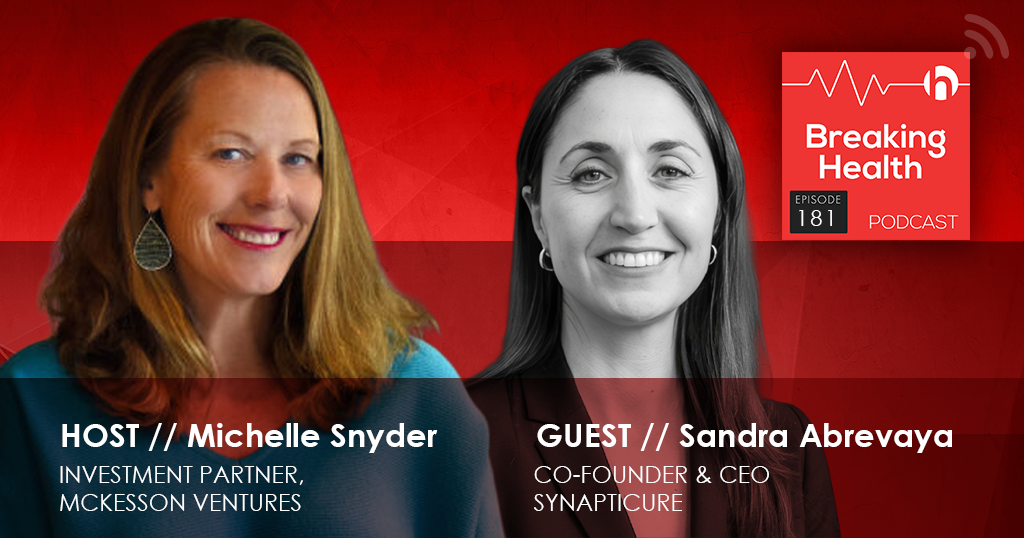
When new treatments, trial opportunities, and better care pathways exist, the real question becomes: can patients reach the neurodegenerative disease specialist fast enough for it to matter? Sandra Abrevaya, co-founder and CEO of Synapticure, joins the podcast with host Michelle Snyder to unpack how she and her husband turned a personal ALS diagnosis journey into a mission to change access to neurology care at scale. Abrevaya shares about founding I Am ALS and helping drive major federal progress in ALS research funding and legislation, as well as opening doors for Alzheimer's, Parkinson's, and other neurodegenerative disease research. The conversation also digs into the gap between scientific breakthroughs and real-world care delivery, the “care and cures” strategy, and why Synapticure treats clinical data as a core asset from the start.
If you care about virtual specialty care, dementia care models, and faster clinical trials, subscribe, share this conversation with someone in healthcare, and leave a review so more listeners can find the show.
GUEST BIO
Sandra Abrevaya, J.D., Co-Founder and CEO, Synapticure
Sandra Abrevaya is the co-founder and CEO of Synapticure, a leader in neurodegenerative virtual care. Synapticure provides transformational support for patients and caregivers through access to specialized neurologists, cutting-edge medical treatments and trials, and personalized, wraparound services. She is also the co-founder of I AM ALS, an advocacy organization she established with her husband, Brian Wallach, after his ALS diagnosis in 2017 at the age of 37. Before Brian's diagnosis, Sandra served as the founding CEO of a nonprofit organization and held senior roles in public service, including positions with the City of Chicago, the U.S. House of Representatives, the U.S. Senate, the U.S. Department of Education, and the White House. Sandra's journey is shaped by her dual role as a caregiver—to Brian and mom to their two spunky daughters, aged 7 and 9—and as an advocate. Their story is the subject of the documentary For Love and Life, which highlights their fight against ALS and their commitment to making a difference in the lives of others facing similar challenges.
HOST BIO
Michelle Snyder, Investment Partner, McKesson Ventures
Michelle is a partner at McKesson Ventures. The firm invests in venture and growth stage companies that build innovative software and tech-enabled services businesses for the healthcare and pharma industries. The Ventures team has deep healthcare investing and operating experience – and brings the expertise and connections of McKesson, one of the large healthcare companies in the world, to help portfolio companies succeed. Michelle ‘s investments include Atropos Health, Midi Health, RxVantage, Galileo, Lumata Health, and CancerIQ.
Before joining McKesson Ventures, Michelle spent over 20 years helping build digital health companies in chief marketing officer and GM roles, including building Epocrates into one of the most beloved physician technology products. Prior to McKesson, she worked in other operating, investing and consulting roles at Welltok, InterWest Partners, the Lewin Group and the Wilkerson Group. Michelle received her master’s degree from Kellogg School of Management and her bachelor’s degree from Carleton College. While she will always be a cheesehead from Wisconsin at heart, she calls the Bay Area home and enjoys hiking, paddleboarding, and traveling the globe finding new adventures with her husband and son.
TRANSCRIPT
Welcome to the Breaking Health Podcast, a series of discussions with the most disruptive CEOs and leaders in digital health.
Michelle SnyderHi everyone, it's Michelle Snyder, and I'm a partner in McKesson Ventures. And I really want to thank you for joining episode 181 of the Breaking Health Podcast. It's a very exciting week. Number one, we're down to the quarterfinals in the World Cup after a very crazy Argentina-Egypt game. And number two, I have Sandra Abrevaya, the CEO of Synapticure, who is joining me today. And I know I mentioned this on previous podcasts, but one of the reasons I love co-hosting this show is the ability to have really candid discussions with passionate entrepreneurs who are driving change in the industry. And Sandra, as you will hear, fits that bill to a T. So with that, I want to welcome Sandra to the show.
Sandra AbrevayaThank you so much for having me. Really excited to share with everyone today and also just to chat with you. Great.
Michelle SnyderSo
I know Synapticure is very personal for you, Sandra. And before we dig into the company and more specific questions about the business model, I wanted to step back and have you talk about your and Brian's journey from the White House to Synapticure. And, you know, maybe one of the things that will probably come up is, you know, why you felt the need to move from advocacy to entrepreneurship. Absolutely.
Sandra AbrevayaSo my husband and I actually met in 2008 on the Obama campaign. I had been working in government for some time when I ended up meeting Brian. I had just served for three years as Senator Durbin's press secretary and had the benefit of working out of his office in the US Capitol and watching how legislation proceeds and, you know, just a lot of innovative work that fueled me and continues to fuel me in terms of public service. And so when Brian and I met, we were on the campaign in New Hampshire, and Brian was a bit of a newbie to politics. And I was a little bit of, you know, a seasoned veteran at that time. And we ended up dating. And then we ended up after the campaign working together in the Obama White House. So we are one of the sort of the couples that came out of that campaign and had really a little bit of a fairy tale relationship and journey. And when we even worked together in the White House, when I would be stressed about work and Brian was just down the hall, we would take a lap around the executive office building and chat about our challenges.
Sandra AbrevayaAnd Brian has always leveled up my work ethic. I consider myself a very hard worker, but every night at 7 p.m., I'd want to go home after starting at 5 a.m. And Brian would say, I have a great idea. Let's go get salads, then come back to our desks and just put in a couple more hours. So that is all to say that we have a very special partnership. And over the years, just had the, you know, fortunate opportunity to both be partners for each other in our personal lives and at work. And so, you know, over time we ended up moving back to Chicago. And I say that because I'm from Chicago, born and raised here. And I had spent then more than 10 years working in government in DC across a number of different stints. And Brian came to Chicago with me. We got married. We started our family. And at the time that we sort of hit this milestone that I'm about to share with you, Brian was working his dream job, which apparently wasn't even in the Obama White House. He was serving as an assistant United States attorney for the Northern District of Illinois, an incredibly meaningful role. He was prosecuting gangs and violent crimes. It was, it was a really tremendous opportunity and sort of his dream job.
Sandra AbrevayaAnd I was at the time, I had co-founded and run as CEO to different education entities in the city of Chicago and was also really enjoying my career. We had a two-year-old. We were expecting our second. And then the day we came home from the hospital with our second daughter, Brian went to a follow-up appointment with a neurologist that I didn't really think twice about. And when he was running late, I called him and said, you know, where are you? You know, we had a newborn sleeping and a two-year-old sleeping in the house. And I was stressed about why he wasn't back. And my husband, who was like the consummate optimist, when I asked him if everything was okay, he said no. And that made my heart stop because again, there's rarely a moment where Brian feels that way about anything. And I asked him what was wrong, and he said he needed to come home and tell me. So as he pulled up, I ran to the car that was parked in front. And he told me that at this follow-up appointment, alone with a general neurologist in the room, he was told that he likely had ALS.
Sandra AbrevayaAnd at the time, probably like most of us, I was pretty unfamiliar with ALS. And so I racked my brain. What do I know about ALS? And I thought, okay, there was the ice bucket challenge. We made progress. And I said to him the following words, it's not that bad, right? And he said, it is. And the doctor told me that I might have six months left. It was absolutely impossible to comprehend how my seemingly healthy husband of 37, sitting next to me in a parked car with our newborn and two-year-old at sort of the height of our careers, of our personal prime, could feasibly have six months left to live. And as we digested that, as we came into the house and we registered the shock, Brian's first thought was, can we go to the Verizon store? And I thought, why? And he said, Because if I don't have a lot of time left, the girls are very young. And I want to go increase the memory on my iPhone so we can take more videos of us together as a family so they remember who I was. And that is the first thing we did within the hour of Brian telling me that he was given this terminal diagnosis and potentially six months left to live. We took our newborn and our two-year-old and we stroller to the Verizon store and we spent three hours there because Verizon is very inefficient. And that, and that is our diagnosis journey. We, of course, over the following several months, had appointments with all of the nation's leading experts and flew around the country and tested and retested and tried to rule out any other diagnosis. At one point, he was being evaluated for whether some of the
signs suggested cancer and we were praying for cancer. And very unfortunately, after several months, it was confirmed without a doubt that this was ALS. But what was also a bit clearer a few months into the journey was that there are patients who decline within six months and that's all they get. But there are also patients who may get several years. And after several months of diagnostic tests and meeting with physicians, we came to believe that we would be in a category of patients that had a little bit more time. And so that is when we began to think, what can we do? What can we do to save Brian's life and potentially have an impact on so many others? And so at the time we were government nerds. Again, I worked for a congressman, for a senator, for a cabinet secretary in the White House, and for the mayor of Chicago.
Sandra AbrevayaAnd so Brian and I knew what it took to write legislation, to pass legislation, to drive federal funding, to institute regulatory reform. And so we decided that we had a unique opportunity to have an impact on the sector and accelerate progress to cures. And so we co-founded within a year of being diagnosed, I am ALS. And since founding it, it has generated 1.6 billion additional dollars in federal funding for ALS research.
Michelle SnyderWow.
Sandra AbrevayaAnd we have written legislation called Act for ALS that was signed into law by then President Biden that provides expanded access program options for patients who are locked out of clinical trials because they are too far progressed and also gives us critical additional data. We have instituted FDA regulatory reform, asking for increased flexibility and a reliance on secondary endpoints and accelerated approval options. And coming out of all of that success and learnings, we saw so clearly that neurology is where oncology was 20 years ago. We are finally at the point where new treatments are breaking through. And Brian and I had a front seat in all of these new ALS drug approvals and processes with the FDA. We supported our colleagues in Alzheimer's and Parkinson's to help them navigate the FDA.
Sandra AbrevayaAnd also saw two new treatments emerge for Alzheimer's, the first that we believe are of many. And we said to ourselves, what does it matter if new treatments break through for neurodegenerative diseases? If patients have to wait eight to nine months to get an appointment. And now, more than ever, both the treatments that are available alongside the clinical trial opportunities and care plans are having a direct impact on outcomes. And it matters more now than ever for patients to see a neurologist within weeks and not months. And so we decided to launch Synapticure, which is a virtual care company
with doctors who specialize in Alzheimer's, Parkinson's, ALS, Ataxias, Huntingtons, really a broad spectrum of neurodegenerative diseases where patients can see a specialist doctor to get diagnosed and treated within weeks and not months. It is a virtual care model. It is available in care deserts. It is available to patients who have a doctor that they're able to get to, but need supplemental care because they can't travel to see that academic medical center more than once every four months. It's really a virtual center of excellence. And it's built on my and Brian's experience as a patient and a caregiver in this sector. And it is reaching thousands of families today. And it really is continuing to grow at an incredible rate.
Michelle SnyderWell, first of all, thank you for sharing that story. I know, as I mentioned, this is very personal to you. And you have been an incredible champion for people with neurological diseases. So thank you. Thank you for that. And one thing I've heard you say before, and now it's clear in what you've said here is I mean, you are great at the advocacy part, but the advocacy can't solve the access problem, right? And so that was really like what was the impetus for Synapticure. That's right.
Sandra AbrevayaAnd there was a second and continues to be a second thesis that accompanies the access to care challenge that Synapticure addresses. And that is coming from Mayan Bryan's experience working with the FDA and being steeped in what does the data look like for meeting the primary endpoint in this clinical trial? And how can it be that it's working for a subset of patients and yet the drug might not get approved because there aren't enough patients in the cohort that meet the endpoint to justify approval? And when you really unpack it and you're in the weeds with the FDA statisticians, as Brian and I have been, what you realize is that if life sciences therapeutics companies don't have a robust enough data set at the front end, it inhibits their ability to optimize how they design the clinical trial and in turn the clinical trial's success rate. And so we knew that if we built the largest provider of neurology care, we would also have the most robust longitudinal data set of patients living with neurodegenerative diseases that could then in turn partner with life sciences companies and further accelerate the development of targeted
therapies.
Michelle SnyderThat's really interesting because one thing as an investor, I often see are kind of care companies and models who maybe the pharma part of the business is an afterthought, right? Or they think we have these patients. Oh, maybe we can do something in trials, or we have this data. Pharma may want to buy that, right? But it sounds like this was a very intentional decision up front, and now is becoming part of your revenue stream as well.
Sandra AbrevayaAbsolutely. And really, we think of synaptic cure as having two arms, care and cures. And for care, it's all about that access to care for high-caliber sub-specialty neurologists and care coordinators and behavioral health team specialists. And then for cures, it's all about partnerships with life sciences companies to accelerate the development of targeted therapies. And as we've built the business, we really are differentiated in having those two revenue streams and two missions that are very complementary.
Michelle SnyderCan you dig a little bit more into the data? And what is the data that pharma can't get today that you can provide for them?
Sandra AbrevayaAbsolutely. So, first, when you want a control group data set, that is very difficult to get. And given the patient population that we serve, that's something we can provide and partner with life sciences companies on, is a control set. Second, if a life sciences company can look at a broader data set and say, our therapy is most likely to be effective for people with, and let's just take ALS, limb onset ALS instead of bulbur, folks who are showing issues with tremors in a certain part of their body initially, and potentially a certain respiratory score and progression. If they're able to really look at a broader set of data and then say, okay, this clinical trial actually shouldn't just be targeted for everybody. Let's be more strategic about it. Let's set it up to target this particular subset of the population. And if we do that, then we're more likely to meet our primary endpoint and then get approval, as opposed to what we see today, where they don't have enough data up front. And so they don't have as strong an ability to sub-segment their population when they're designing their clinical trial. And then the heartbreaking human component of this that Brian and I have watched take place over and over again is that you see a treatment that is working for some subset of the population and then it fails to meet its primary endpoint and it gets pulled.
Michelle SnyderYeah.
Sandra AbrevayaBecause the treatment and the trial was not targeted enough from the outset.
Michelle SnyderSo what you're doing is really benefiting patients who need to know about these trials and match with the ones that will work for them, but also pharma who wants to bring these drugs to market, but as to your point, it doesn't have the right data. And there are more use cases.
Sandra AbrevayaSo we can partner to provide data on, you know, in a de-identified way, on the patient journey analytics, on adherence. There's a number of ways we can support once a treatment is commercialized so they can continue to optimize the experience for patients. We can also serve as a virtual center of excellence and clinical trial site. And we've done that, a version of that in ALS. And what we've demonstrated is that we're able to enroll patients faster than other sites. We're able to enroll patients from a more diverse geographic setting, socioeconomic setting, and really tackle a lot of the classic challenges in the clinical trial setting. Because one, we have reach. Two, patients can engage without needing to go into clinic. And three, because we have a lot of credibility with the patient community, given all of the work we put in for the five years before we even launched synaptic care.
So, how does the care model actually work? How do you find the patients? How do you work with the patients and the caregivers?
Sandra AbrevayaAbsolutely. So there are two ways that we find patients. One of them is how the company started. Brian and I have public platforms on social and otherwise. And we just announced to the community that we felt a need for a better, more accessible care model. And we built it, and it's now ready for the community to engage with. And that direct-to-consumer approach has continued to be an important part of our approach. And as the company has grown, we have now really great partnerships with Common Spirit in the Northwest, with Pearl and ACO, with Presbyterian. And these health system partnerships are addressing needs that health systems have to provide really robust dementia care support, whether that's early stage in assessing a patient's eligibility for one of the new amyloid targeting therapies called ATTs, whether that's just a robust set of chronic care management interventions that our team is able to do, because this is our specialty. In those cases where we partner with a health system, we share records, we're in constant communication, we also have a really flexible model to sort of address what each different health system needs, support on. Sometimes they just need diagnostic support, and we can play that role. Sometimes they're able to handle the diagnostics, but then they don't have capacity to handle the care management moving forward. Sometimes they're not equipped to navigate the decision making and the safety monitoring that is required as a patient and a family thinks about amyloid targeting therapies as an option because this is all very new. So we are able to be very flexible and to really partner in a deep way to make it work for health systems.
AnnouncementAre you enjoying the conversation? We'd love to hear from you. Please subscribe to the podcast and give us a rating. It helps other people find and join the conversation. If you've got speaker or topic ideas, we'd love to hear those too. You can send them in a podcast review.
I'm glad you brought up dementia because my guess is that there are a lot of people who think you just help ALS patients, right? Because that's where you started. And I think one of the things I read is you actually are one of the larger guide providers in the country. So maybe talk a little bit more about that and the program. And was that an easy transition from ALS to other neurological conditions? I don't know how similar or different your model needs to be. Absolutely.
Sandra AbrevayaSo from the outset, when we started with ALS and the ALS population, we were actually already serving a subset of the dementia patient population because for ALS patients, in particular those who have the C9 gene, they often face both ALS and FTD frontal temporal dementia at the same time. So from the very earliest of days, we had overlap between our ALS and dementia needs. As we then built out into To Parkinson's and Huntington's next, there are a significant number of Parkinson's patients who also are dealing with Lewy body dementia. So again, we were overlapping with dementia needs, even as we expanded to Parkinson's. And then ultimately, we launched all Alzheimer's care, all related dementia care, above and beyond ALS and Parkinson's patients. And that moment coincided with the Center of Innovation at CMS, CMMI accepting applicants for a new dementia care model that they wanted to support that is very anchored also on how you relieve caregiver burden. It turns out that's the version of care we've been offering from the get-go because I am a caregiver and I am a co-founder and the CEO of the company.
Sandra AbrevayaAnd so our model was already very aligned with CMMI's guide model. And in turn, when the first round of applications went in, we were accepted in the first cohort and we were accepted as a partner to CMMI in all 50 states. And so today we obviously maintain that footprint, but importantly, we've scaled and are, as you said, one of the leading providers for the guide program for CMMI and able to partner with health systems across the country so they can participate in the guide program by partnering with us, which is difficult to create that infrastructure for and to get the bones in place. And we've done that. So we make it really straightforward for health systems to be a part of the guide program when they want to partner with us. And then stepping back even further, even aside from our guide participation, we serve patients fee for service who are cognitive patients. And so you put all the pieces together. And today, the lion share, most of Synapticure's patients are navigating Alzheimer's and related dementia. It is the biggest part of our care services and it is the fastest growing. And that was always part of the plan.
And I mean, you're not just part of the, I mean, you are part of the guide program, but some of the results you shared with me. I think you had some published recently or you're about to publish them. You're doing really well in four patients that are part of that program. Can you talk a little bit about the outcomes that you're showing? Absolutely. And then also maybe why why are you able to achieve these outcomes when others are not in the program? Absolutely.
Sandra AbrevayaSo we recently published a white paper and we've shown a 25% reduction in all-cause admissions, ED admissions. We also are reducing the number of patients that transition to long-term care, right? Because if you better support the caregiver in their home, then the caregiver is equipped to navigate it for a longer period of time before transitioning out. And so what we've shown there in terms of outcomes is that inpatient rehab days fell 24.2%. Well, you know, peers who did not have this intervention actually saw a 14% increase. Home health visits fell 11.6%, and a number of other really concrete impact points that I think and the team sees as taking place, one, because we have a very high touch model. It was always envisioned to have both a neurologist and a care coordinator together supporting the family, as well as then layering on behavioral health. There are other entities in the dementia space that do take a lighter touch approach. They don't all have subspecialty neurologists that are a part of this care. They don't all have psychiatrists and psychologists that are a part of this care. Our approach from the outset was, again, to mimic a virtual, you know, to mimic a center of excellence to be a virtual center of excellence, right? And I think that that's an important differentiator because probably individuals who started other healthcare startups and companies are thinking from the get-go how to optimize to be as light touch as possible. And yet, you know, when we started, we started rooted in how to best support families and that that required a little bit of a higher touch and that it would pay off. And it has.
Michelle SnyderI think I had seen something published during the high 90s, which is pretty incredible. Yeah. We have incredible NPS.
Sandra AbrevayaI think, you know, it's it's both the caliber of the physicians we recruit and it's their empathy. It's their preparedness for the appointments. We we bring into the prep for the physician what the patient wants to talk about, what clinical trials they have questions about, what treatments they have questions about. And so they feel listened to. They feel that the physician and the expert they meet with is a true expert, is prepared to answer their detailed questions. And we also do recruit physicians and care coordinators who have lived experience. In the early days, the majority of the care coordinators that we employed were all, you know, essentially either had a spouse or a parent pass away from ALS. And, you know, the build-out of that has evolved over time, but we try to maintain that approach as much as possible because a high NPS score is about both head and heart. And we know that both are
important. Yeah.
Michelle SnyderYeah, it's interesting thinking about that because as an investor, I mean, one of the challenges I often see with care companies is as you scale, like you're doing, the ability to manage the provider supply with the patient demand and making sure one, you have people who understand the patient population, are specifically trained for the type of patients you're dealing with. And you don't want to overhire because that's a hit on your margins. You don't want to, you want to be ready to serve patients, but that often involves lead time. So, how do you manage that at Synapticure?
Sandra AbrevayaI am very fortunate to be surrounded by an incredible executive team that is very good at a number of things, including that. It is critically important to get that fine-tuning right. Yeah. Obviously, for margins for all sorts of reasons. And I'm surrounded by experienced operators and people leaders and physicians who focus on that incessantly in the best way. And I'm very, very grateful and fortunate to have that team.
Michelle SnyderAnd I'm assuming you're you're that those are the metrics you're probably tracking weekly or maybe--
Sandra AbrevayaAbsolutely. Yes.
Michelle SnyderSo you've been at this, I mean, I guess four years on post five, maybe before the start the company even started. Was there a specific moment or moments when you just started feeling like this is actually working? Like we can do this.
Sandra AbrevayaI think that seeing that the scale and the build from ALS to Parkinson's to all of Alzheimer's worked, and that the health system partnerships began to augment our direct-to-consumer channels was the moment when it was clear that we have product market fit, that this will scale, and that there's just incredible opportunity moving forward.
Michelle SnyderSo one of the things I like to ask entrepreneurs is about pivotal moments in the company or decisions that you made that then had a big impact on the direction of the company. And it could be positive or it could be maybe a decision that you you wish you hadn't made. Are there any things you can think of there where, you know, I don't know, maybe it was the decision to work with a specific health system or some a decision you made around the care team could be anything.
Sandra AbrevayaI think that every founder and CEO experiences this transition as you go from seed stage to A, which is that in the early days, you hire the best physicians and care coordinators, and everybody sort of marches forward, putting their best foot forward. And that's, you know, a version of your care plan, right? But then you do need to evolve and you need to tighten up the operations. You need to have standard appointment lengths, you need to have standard cadence for follow-up visits, you need to have standard referral processes over to behavioral health and care coordination from the physician. And that standardization is a hard moment for any care team. And especially when they've experienced one version of care delivery, and then you need to evolve and you need to mature.
Michelle SnyderAnd sometimes some people don't evolve with the company, right? And many do, yeah.
Sandra AbrevayaThat's right. That's right. And I think that we've been willing to part ways when that's the case. We've kept our eye on the ball and know that we have to continue to always improve our operations and our workflows and standardize and see, as you said, margins continue to strengthen more and more over time. And at the end of the day, that's what you have to do to be able to deliver the care you want to deliver. And there will be some bumps along the way and some people you have to part ways with, and that's okay. What are you most excited about in the coming year for the business? I think that we now have this really beautifully established reputation, both with health systems and in the direct-to-consumer avenue. And I think we're about to hit this turning point where it's going
to unlock and growth is going to accelerate at a rate really beyond even what we've seen in the last couple of years, because we're now really, as we've talked about, seen as a leader not only in the Guy Dementia program, but more broadly as, you know, essentially one of a couple leaders in the Alzheimer's space and continuing, you know, to expand. And so I'm excited for the growth. I'm excited to reach families that only see a PCP and need so much more. I'm excited to reach people in rural areas, in care deserts. I'm excited to partner with health systems that are willing to admit that they have an eight-month wait and that it behooves them to work together to innovate and partner together to scale these types of programs. I'm excited for all of that opportunity.
Michelle SnyderWell, I'm excited too. I remember a couple of years ago seeing a statistic about the number of patients with neurological conditions who've never actually seen a neurologist. And it's heartbreaking. It really is.
Sandra AbrevayaIt really is heartbreaking. I mean, especially coming back to where this conversation started, if there are new treatments getting approved, how in the world would a PCP know about them? If there are new groundbreaking approaches to standard of care, which we implement that, you know, as we've shared, reduce ED visits, delay transition to long-term care, how in the world would a PCP be able to provide that for a family? So maybe it mattered less 10, 15 years ago if you didn't see a neurologist. But we have interventions now. We have care interventions and we have treatment interventions that are extending life and improving outcomes. And it's just heartbreaking for people to not have that access.
Michelle SnyderSo this is gonna be more of a fun one. I was thinking the other day about one of my son's favorite TV shows to watch when he was younger, and it was Mythbusters and reruns of Mythbusters. And , while my son was definitely more interested in the explosions versus thinking about healthcare, I personally am always intrigued to hear from entrepreneurs about, you know, what myths about the business they often have to bust in the market. And so I'm guessing you may have a few. Sandra, tell me, are there some myths that you're constantly busting? Yes. Okay, I'm gonna name three myths.
Sandra AbrevayaOkay. Myth number one is that you can't diagnose Alzheimer's and related dementia virtually. What the research has shown is that it is actually beneficial to have the patient in their home and natural setting where they are comfortable and they are most in their standard state of mind, so to speak. And the assessment largely consists of a series of questions that the neurologist asks. There are a few other components also that can be done over video successfully. And so that has continued to be a myth to bust is that it not only is possible to diagnose Alzheimer's and dementia virtually, but it is sometimes better.
Sandra AbrevayaOkay. Myth number two is that these are the worst diseases. How in the world can you help people virtually? They're so complicated. You must need to go in person. The lion's share of what families, my own included, need from neurologists in our doctor appointments is guidance. We want to know what are the latest treatments, what are the most promising clinical trials? Given my genetic data, given my biomarker data, given my limb onset versus arm onset, or how my dementia is progressing, which one physician do you recommend? How can you, you know, help me assess the landscape of options? And that's really what patients need. And when you do these visits virtually, the physicians have more time with patients. Our physicians, as we've talked about, come to the table prepared to speak to the patient's questions. And if you do the appointment virtually, you can have the people in the room with the patient, obviously, a part of the visit. And critically, you can have another family member who lives in another state join the appointment. The number of times that a patient in a traditional setting has an appointment, perhaps with a paid caregiver who brings them in. And then there's an attempt to translate the takeaways from the visit, maybe over visit notes or through the paid caregiver to the family, and how much gets lost in translation. There is so much benefit to having these appointments be virtual. And the lion's share of what patients need in these visits isn't to be poked and prodded, but to be able to ask for expert guidance.
Michelle SnyderAll right, myth number three.
Sandra AbrevayaMyth number three is that people don't believe that the vast majority of individuals living with these diseases only see a PCP. They don't realize how dire the current situation is. They assume that if someone is contemplating whether they have an Alzheimer's diagnosis, that they would, of course, see a neurologist. They don't realize that it's an eight to nine month wait. They don't realize for the vast majority of Americans, it's not even financially feasible to fly to an academic medical center. It's not feasible to wait eight months to get some care recommendations. I think myth number three is maybe anchored on the fact that the general public doesn't understand how dire the status quo is and how urgently we need changes.
And with that, thank you so much for joining, Sandra. The industry is very lucky to have you and Brian championing for change.
Sandra AbrevayaSo really appreciate your joining. Thank you so much for having me. I'm so excited to talk about all things neurology whenever you want.
Michelle SnyderSounds good. And actually, one more thing before I sign off, for those of you who haven't seen it, I wanted to mention the doctor documentary for Love in Life, No Ordinary Campaign. It's a documentary about the story of Brian and Sandra's journey in launching the I Am ALS movement. And it chronicles their success in some of the funding she talked about and passing the bipartisan legislation through a lot of grassroots efforts and just frankly perseverance, which you will see in the movie. It's really inspiring on many levels. So I think you can find it on Apple TV or Prime. And I hope you watch it if you haven't.
Sandra AbrevayaYes, it's on Amazon Prime. Oh, Amazon Prime, got it. And produced by Katie Couric, who, by the way, is a lovely human.
Michelle SnyderOh, all right. Well, something I didn't know. I'm gonna have to rewatch the documentary now with that in mind. So, with that, thank you everyone for tuning into this episode. And we look forward to bringing you another Breaking Health podcast.
Sandra AbrevayaThank you.
Michelle SnyderGoodbye.
Do You Have
A STORY TO TELL?

If you’d like to be considered as a guest on a future episode of the Breaking Health podcast, please complete the application today.
Meet Our Hosts
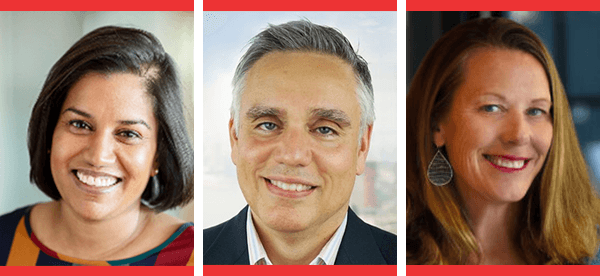
Payal Agrawal Divakaran, .406 Ventures
Steve Krupa, HealthEdge
Michelle Snyder, McKesson Ventures
Subscribe ON iTUNES

Don't miss an episode. Join the conversation by visiting our podcast channel on iTunes today and subscribe. It's fast and free!
 SUBSCRIBE ON iTUNES