Candid Conversations with Digital Health Innovators & Business Leaders
Welcome to the Breaking Health Podcast
Conversations between VCs and entrepreneurs typically occur in boardrooms or coffee shops. In the Breaking Health Podcast, you get a seat at the table. Our hosts bring their investor insight to revealing conversations with the most disruptive CEOs in healthcare. Listen to understand how these leaders are building the companies – and fostering the cultures – that will change everything.
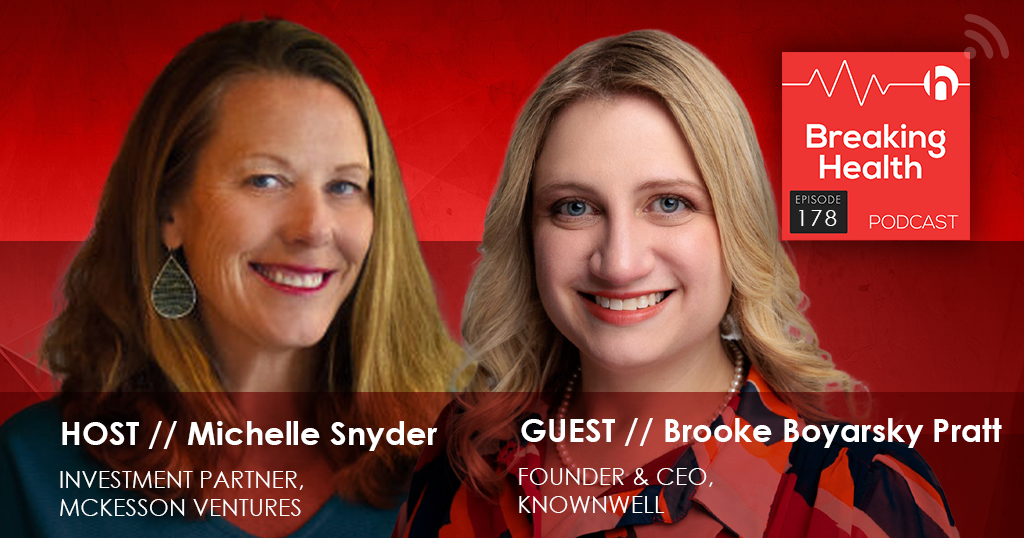
What will the obesity landscape look like in the next few years? Brooke Boyarsky Pratt, founder and CEO of knownwell, shares her thoughts on the impact of GLP-1s on Breaking Health, hosted by Michelle Snyder. Boyarsky Pratt also discusses the shifting mindset on treating obesity as a disease instead of just an issue of willpower, creating a space for obesity patients to feel comfortable seeking help, and the use of AI, as well as the impact of pivotal decisions toward company growth and lessons learned from expanding into new markets.
GUEST BIO
Brooke Boyarsky Pratt, Founder & CEO, knownwell
Brooke Boyarsky Pratt is the founder and CEO of knownwell, Inc. Prior to knownwell, she was the chief operating officer of production at Berkadia, a joint venture of Berkshire Hathaway and Jefferies Financial Group, after leaving McKinsey & Company as an associate partner. Brooke graduated summa cum laude from the University of Pennsylvania and as a Baker Scholar from Harvard Business School. She has spoken extensively about her weight and gender issues throughout her career (NY Times, Ted Talk, HBS graduation as the Class Day speaker).
HOST BIO
Michelle Snyder, Investment Partner, McKesson Ventures
Michelle is a partner at McKesson Ventures. The firm invests in venture and growth stage companies that build innovative software and tech-enabled services businesses for the healthcare and pharma industries. The Ventures team has deep healthcare investing and operating experience – and brings the expertise and connections of McKesson, one of the large healthcare companies in the world, to help portfolio companies succeed. Michelle ‘s investments include Atropos Health, Midi Health, RxVantage, Galileo, Lumata Health, and CancerIQ.
Before joining McKesson Ventures, Michelle spent over 20 years helping build digital health companies in chief marketing officer and GM roles, including building Epocrates into one of the most beloved physician technology products. Prior to McKesson, she worked in other operating, investing and consulting roles at Welltok, InterWest Partners, the Lewin Group and the Wilkerson Group. Michelle received her master’s degree from Kellogg School of Management and her bachelor’s degree from Carleton College. While she will always be a cheesehead from Wisconsin at heart, she calls the Bay Area home and enjoys hiking, paddleboarding, and traveling the globe finding new adventures with her husband and son.
TRANSCRIPT
Announcement:Welcome to the Breaking Health Podcast, a series of discussions with the most productive CEOs and leaders in digital health.
Michelle Snyder:This is Michelle Snyder, a partner at McKesson Ventures, and I am so excited to have Brooke Boyarsky Pratt, the CEO of known well, joining us today. One of the reasons that I love hosting this podcast is the ability to have really candid discussions with passionate healthcare entrepreneurs who are really helping to change the status quo. And Brooke definitely fits this definition. I actually remember the first time I met Brooke and I heard the known well pitch, and I thought, yes, this is finally how we should be treating people who are struggling with our weight. And so for those of you who don't know Brooke or known well, I'm really excited to have you hear this story and meet her. So, Brooke, welcome to the show. Happy to have you here.
Brooke Boyarsky Pratt:Thank you so much. I am so excited to chat today.
Michelle Snyder:Great. Obviously, we're gonna get into the company and what you do and questions from a business angle, but before we do that, I want to talk more about the journey. Because one of the things I noticed about you when I first met you is your passion. And I know many healthcare entrepreneurs are very passionate about what they're building and you kind of have to be to take the risks that you do. But to me, you are a 10X on the passion scale. And so I'd love to kind of start there. Did you always know you wanted to start a company? And you know, if so or if not, what actually made you take the leap?
Brooke Boyarsky Pratt:I definitely did not know I wanted to start a company. In fact, when I got my MBA at Harvard Business School, I took a couple of classes on entrepreneurship, and those were enough for me to know like I might join a growing startup, but I don't really have any interest in being an entrepreneur myself, and certainly not one in healthcare. So I was truly called to known well. I mean, I really do feel that way. I had been kind of in traditional business settings, McKinsey as the COO of a Berkshire Hathaway company, none of that in healthcare. I had had an experience my whole life of trying to navigate the healthcare system as a patient with obesity. And I just took it for granted that I had so much trouble finding an integrated healthcare home where I didn't feel stigmatized about my weight and I could get care for my obesity. But this really came down to a moment where I had in which I had moved to Chicago and was re-establishing primary care and ran late to my appointment because I didn't want to go and meet a doctor for the first time if I didn't have a Harvard shirt on, because I had found that that was a way to confer to the clinician that despite having obesity, I really am a smart, thoughtful person. And that night I just really reflected on how crazy it was that I ran late to my appointment because of that. And for the first time ever, I decided to Google if that's a common experience. I was overwhelmed by the research. And I will just say I spent two years trying to talk myself out of it. I had an amazing job that I loved. I had a brand new baby, and I truly felt like I had to do this almost against my will, like I was put on this earth to do it. I never had understood founders who said things like that before until it happened to me.
Michelle Snyder:Wow, that I mean, that's an incredible story, but also the just thinking that you were worried to go to the doctor and that you needed to wear your Harvard sweatshirt to do that. And I think, you know, your experience there, and we'll talk about it a little later, I think has really shaped how you've built the experience, right? For everything from the waiting room to how you welcome patients, etc.
Brooke Boyarsky Pratt:Absolutely.
Michelle Snyder:We why don't we start with known well and you can tell us a little bit more about what the company does and the business model, and then we'll dig in from there. Sure.
Brooke Boyarsky Pratt:So you probably asked our mice from my from my story there. We're the healthcare home for patients with overweight and obesity. So what we mean by that is we can deliver primary care, we can deliver obesity medicine and all of the pillars of metabolic health that that entails. And we can deliver both of those things, right? So primary care and obesity medicine with a W-2'd interdisciplinary care team. So we employ doctors, APCs, dietitians, health coaches, endocrinologists, et cetera, to really be able to see patients for all of their needs. We deliver that care both in person for some patients and virtually for most of our patients. So we have clinics in some states. I know we'll talk about that a little bit later. And in those clinics, we can do, you know, additional primary care services. And then we can also see a patient fully virtually, which we do across 50 states today. We're primarily a fee-for-service business and we pride ourselves on access. So we take in commercial insurance, Medicare, in some states, Medicaid, and we do not charge a membership fee.
Michelle Snyder:Can you talk a little bit more about do you have a target customer? And if so, how do you find and acquire the customers?
Brooke Boyarsky Pratt:Sure. So I know it it sounds a little broad to say our primary customer is someone with overweight or obesity, considering that's 70% of the US. And when I had originally thought of the idea, I thought, look, I really want to build this for patients who have, you know, been avoiding care because of their obesity. Again, it turns out that's the vast majority of that 70%. So what we see in practice is we lean about 70% women. Most of our patients have two to three comorbidities in addition to obesity. And most of our patients are between the ages of 35 and 65. So we certainly see older, we see younger, we see men. But as you think about kind of our cohort who who tends to choose known well, it is those women with two to three comorbidities who are between 35 and 65. Got it.
Michelle Snyder:Great. And one of the things you you mentioned, which I think is a good area to dig on, is you are a you know hybrid model. You have physical locations, you also have, you know, 50 state coverage virtually. And you know, I think that can be more unusual from an investor point of view in terms of companies. A lot of what we've seen over the last couple of years, the focus has been on virtual. And you know, being a hybrid company definitely can have its challenges. It's sometimes it can be a little harder to scale, sometimes it can be a little harder to raise money from investors. I'm curious why you made that decision and then how you thought about how that decision might impact your growth strategy.
Brooke Boyarsky Pratt:Michelle, I don't know what you're talking about. Investors love a primary care company with physical clinics. I'm just kidding. For sure. I mean, look, it was it was a big decision for us when we started known well. We knew the challenges that would come with that model, but we believed that some degree of a physical presence didn't have to be a lot of clinics, was created a really important competitive advantage for known well. And we have seen that hypothesis hypothesis come to fruition. So, our physical clinics, despite the fact that most of our patients don't go there, don't go to those physical clinics, have allowed us to do a few things. So they allow us to partner with health systems in really unique ways. They allow us to work with numerous pharmaceutical companies to conduct clinical trials with the latest obesity therapeutics, which has been a huge differentiator for known well. And really, for clinical trials, you have to bring the patients in. Very, very few clinical trials can be conducted virtually. And they've also kept our CAC very low by giving us a local present in community, which has driven clinician referrals. So those are kind of all of the business reasons that it's worked for us. I mean, I'll also say most importantly, as it relates to patient care, they do allow us to do some pretty cool stuff, right? Like super accurate body composition readings and metabolic rate testing, which has given us, I think, the best data in obesity, as well as, of course, offering the full suite of services for some of our primary care patients. I can't tell you how many women have had, for example, their first ever PAP smear at knownwell, because they finally felt comfortable seeing a clinician, even with their overweight or obesity. So really meaningful on the clinical care side and also has created some really interesting competitive moats as a company.
Michelle Snyder:Yeah, that's interesting. I was thinking about when I, you know, first saw your clinic, I want you to talk a little bit about what that experience is like because I remember years ago going for my first visit at one medical, and it was kind of life-changing. I thought, wow, this is not like the doctor's office that I'm used to going to. And I feel like you've created that experience at known well with this specific target audience in mind. Can you talk a little bit for people who have not been in a known well clinic, like what it's like when you walk in and how it's different?
Brooke Boyarsky Pratt:For sure. I think I'm biased. I think we have the best clinics in healthcare for our population. And I'll also mention we spend a lot of time making sure that that experience carries over virtually. So things we've decided to do, we get what I call the little stuff right. So, for example, we ask patients before a visit, virtually or in person, if they're comfortable being weighed. If they aren't comfortable being weighed and we need their weight for some reason, if they're in a physical clinic, our exam tables can weigh them without them having to have the stigma or the feelings they may have about stepping on a scale. They can fit in any of our chairs. Our chairs are not only beautiful, but weight inclusive. Our blood pressure cuffs will always fit for those folks who have had the experience of the doctor or clinician needing to go find a bigger blood pressure cuff. We never do anything like weighing in public. Our exam tables can go all the way to the floor, so like extremely accessible.
Brooke Boyarsky Pratt:And even in some cases, like wider doorways. Again, just trying to be really thoughtful for, you know, how have people felt othered. It's great that, for example, some, you know, like for example, health systems have some chairs that are bariatric. They're ugly, they're few and far between. Really interesting research on like even bariatric patients don't want to use those chairs because they feel othered. Here, everything at know nwell is the same and is just super warm and welcoming and designed forward. But I will just say briefly, like we had to do a lot of thinking about that is we hear from patients all the time such a differentiated experience. Can we create that same weight-inclusive experience virtually? And we really have. And something I'm most proud of is we track really closely not only our overall net promoter score, but our NPS as it relates to virtual and in person. And, you know, over tens of thousands of patients, we're at 91 NPS virtual and 91 NPS in person. So, like patients feel that differentiated experience, regardless of how they see us.
Michelle Snyder:That's actually really interesting. I have a new question I'm gonna ask in some of my pitches. I've never actually thought to ask how your NPS differs in person versus virtual.
Brooke Boyarsky Pratt:Yeah.
Michelle Snyder:I love that.
Brooke Boyarsky Pratt:There's really fascinating research on the power of the waiting room. Like if you're going to invest somewhere in building a physical clinic, the waiting room ends up having like this massive impact on how patients have enjoyed their experience and how they perceived it. And I was really aware that we have amazing, beautiful waiting rooms. Like patients take pictures all the time and put it on social media. So that would like those types of insights are why we were particularly sensitive to the virtual experience, because for example, the waiting room can only be so beautiful virtually. So it's just been an interesting part of our design journey.
Michelle Snyder:Yeah, very interesting. So you had mentioned up front in your description of known well that you are in multiple locations now, multiple states. I'd love to hear a little bit more about that. You had a very successful start in Massachusetts. You know, your co-founder is one of the kind of lead luminaries in the field and had a clinic there. And then you fairly quickly decided to expand to other states. And I'd love to hear a little bit more about maybe the lessons you learned from expanding relatively quickly into kind of markets two, three, and four. And did you have a playbook that you followed from what made Massachusetts successful?
Brooke Boyarsky Pratt:For sure. I think honestly, looking backwards, we underinvested a bit in creating the original playbook. To your point, Massachusetts went well. And we knew logically we would need to pull various levers as we entered new markets, but we just did not have the team or the manpower at the time to really invest like we should. I mean, I think when we became a Series A company, we had like five employees. So you hear a lot of people say, like, I was employee number 40 before we started seeing patients. I mean, we started seeing patients, me and Angela, you know, in my living room, like, you know, virtually when we started. So a big kind of pivotal moment for us was, you know, hiring a chief growth officer who's wonderful and starting to build out our team. So I think when we opened in Texas, which is our second location, we had like maybe 10 or 20 people at known well. And that's including the clinicians and everyone else. So we learned kind of from that Dallas opening, which was fine, but we felt like that could have been faster.
Brooke Boyarsky Pratt:And that's when we really started taking the learnings from both Massachusetts and Texas and developing a playbook. And what we've now seen in future marketing openings like Chicago and Atlanta and our national virtual clinic, we've seen super rapid growth. And kind of every clinic we've now opened has grown faster than the last one. A few things I've learned, none of which I think are groundbreaking. Healthcare really is local, right? As everyone always says. And investing in getting to know the community matters. We literally have a playbook for this now, and it's not expensive, right? It's like hosting an open house and getting the word out to clinicians in the community. It's showing up to local events and really just investing in people getting to know that you're a real clinic. You know, when folks bristle at, you know, the cost of opening clinics, which are actually pretty cheap for us, I can assure you that that saves us five to 10x the cost in cost of acquisition of patients. So I think it's, I like to say it's a little bit more about how you spend the money, like versus just are you spending it or not. We also learned it was important to fly a few key team members in person to those clinics in the first few weeks that they open, just to really be on the ground and smooth out any operational kinks. Um, and then I would say lastly, we learned, like in Massachusetts, when we started, we just, you know, we did we did no investment. We just kind of started getting referrals and getting our name out in the community by like posting on Facebook. We now do a little bit more purposeful investment, really to the things I was talking about earlier.
Brooke Boyarsky Pratt:So, you know, getting to events, getting our name out there, spending a little bit up front. I mean, again, we're talking less than $10,000, but that ultimately builds so much momentum in the local market that again, you I mean, very quickly, more than half of your patients end up being word of mouth, clinician referral, et cetera. So I've, you know, I will say at times I think I have been penny wise and pound foolish. And I've taken a new approach and said, like, let's spend a little bit more up front so that the community gets to know us.
Michelle Snyder:You mentioned the partnership with the physicians, and then early on you mentioned you partner with health systems.
Brooke Boyarsky Pratt:Yeah.
Michelle Snyder:Is that important to have those relationships up front when you're going into these new markets? Or do you just build them over time? We won't build a clinic without one.
Brooke Boyarsky Pratt:And that doesn't mean it's the right answer, right? You know, everybody is gonna going to approach growth differently. And and this is, you know, interestingly, I would say of the things founders ping me about, this is by far the thing that I and my chief growth officer are are asked about the most, which is the partnership strategy with health systems. Our view is one, to improve the economics of putting up a clinic, but two, just as importantly, to make sure that we're well connected into the specialist and procedure community, given the demographic of the patient of our patients I mentioned earlier. We feel more comfortable if we're going to place a physical clinic and we're going to be doing primary care, having a partner in market. Got it.
Announcement:Are you enjoying the conversation? We'd love to hear from you. Please subscribe to the podcast and give us a rating. It helps other people find and join the conversation. If you've got speaker or topic ideas, we'd love to hear those too. You can send them in a podcast review.
Michelle Snyder:So you also had mentioned your chief growth officer as a pivotal moment. And I know you're still early in the journey, but would love to talk about that a little bit more. Are there any other kind of pivotal moments or decisions that you made either early on in the company or could be more recently that really have impacted the direction of the company? And then if so, what led you to make those decisions?
Brooke Boyarsky Pratt:We have made a few of those, right? And I would say how we make those kind of decisions first, just to start fundamentally. One of the first things we did was write our core values, which include being patient-centered, taking the long view, and being data-driven. And you'll see why I mentioned those in a second. And then we revised those values once we had seen a certain number of patients and the company had grown to a larger size. And I'll say the values themselves didn't change, but some of the language we use did. And that's been really important for when we're navigating those tough decisions. So the one I would point out is deciding to not chase compounded GLP ones. I can't tell you how many graphs I've been shown by potential investors, friends, the community of the up and to the right, you know, revenue growth of digital health companies that have leaned into compounded GLP ones.
Brooke Boyarsky Pratt:I will say from the more obvious pill pushers, I think like folks like hims and hers, you know, would be maybe one company someone would name, to less obvious. I think listeners on this call might be surprised if they looked under the hood of kind of digital health companies, how many of them have a significant portion of their revenue that's driven by them prescribing their own compounded GLP ones. You know, early in our journey, we had just decided like that's not something we're gonna do. We're data driven and we just don't, there's no safety and efficacy data. We take the long view. We don't think that's a sustainable outcome for either us or our patients. And we have foregone kind of that explosion of compounded GLP ones. We can talk about all the benefits of that decision, right? I think it's created amazing opportunities with clinical trials and other kinds of partnerships and health systems. Like, I think it has actually created a sustainable moat around our brand that, you know, to take it to weeks like this week, when the FDA has announced they're finally going after all compounded GLP ones, like feels like the right bet, but we gave up something in the meantime.
Brooke Boyarsky Pratt:Another example I'll give, and then I'll pause there, is when we opened up our 50 state virtual clinic, we were super overwhelmed by demand, like much more so because we're not doing any paid advertising. So, like we, you know, we just didn't expect to see a ton of demand at first, kind of virtually. And, you know, because it was clear that patients were going to wait lists, we were, you know, approached by a lot of those companies that can give you moonlighting clinicians, right, who can see patients quickly. And we just felt like, again, even though we're going to give up short-term revenue by not being able to scale quite as fast, if we are building the blue chip highest quality clinical group in obesity medicine, we just can't start looking like everyone else. Um, so those are just two examples, but I would say like being values oriented has has helped us stick to our guns in those moments.
Michelle Snyder:Yeah. And I think those all tie to right outcomes, which I know which are are very important to you. And I remember that when we first met. I mean, that was one of the first things you talked about. You know, the experience is great. You have such high NPS, but I know you were very focused on outcomes and being able to kind of control the experience and the quality probably feeds into that. Absolutely.
Brooke Boyarsky Pratt:I mean, at the end of the day, like one of the reasons obesity has been such a tricky disease for us to make progress on as a country is that it is a disease that requires longitudinal care. And we just haven't been built to deliver that. So Angela and I's view is if we want to have these phenomenal outcomes with patients, we have to create an environment in which they keep coming back. So, like, you know, we have 95% year one patient retention, 91% year two, and really high weight loss sustainment and all that good stuff. And those help economically, of course, that we're not like churning our patients all the time and having to replace them. But that is why both our weight loss and our weight loss sustainment, and by the way, like the amount of lean muscle our patients lose is half of benchmark in the weight loss process. It is because we've built this high-quality W-2 kind of higher touch model, which still has a bunch of technology opportunities that I'm sure we'll we'll talk about later. But that having that ethos is what's delivered those outcomes. And, you know, that's what patients really need in the world of obesity.
Michelle Snyder:So tying a few things together from what you've said over our time together so far. I was thinking about the Harvard Business School sweatshirt. I actually watched your commencement speech at HPS online, which for those of you on this podcast, you can Google it and listen to Brooke. And it was really interesting. It was different than many other commencement speeches I've seen. You talked about being overweight most of your life. You talked about how being overweight impacted your experience at HPS. And then you talked about how what you learned is that obesity is not really about willpower. And I think the GLP ones, however people think about them, I do think one of the benefits to me is that they have helped kind of move the discussion away from this failure of willpower to how do we manage obesity as a chronic disease, given, and as you said, you know, such a large percentage of the population is overweight. I know you didn't go down the compounded route, but what are your thoughts on GLP ones and the impact on the industry? And would you agree that it has kind of shifted the discussion?
Brooke Boyarsky Pratt:Couldn't agree more. I mean, rising tides lift all boats. Like I always say, I suppose I'm most grateful for GLP ones, of course, for the therapeutic outcomes. I'm second most grateful for them for how they've shifted the dialogue, right? Like, I mean, Angela always says there's been, you know, an obesity medicine association for 50 years. So a small group of clinicians for a long time have seen it as a medical disease. But, you know, it was as recently as a little over 10 years ago that the AMA classified obesity as a medical disease. So we're still very early in our journey. And I think that for better or worse, once a medication is introduced that gets this much kind of widespread attention, medications make both, I think, clinicians and patients see something more as a disease because now there's a medicine to treat it. So I am like grateful for how that's continued to evolve the narrative. I think you couldn't have said it better, which is from a lifestyle failing towards a medical disease. We could talk all day about like the negative impacts of that, right? Like the pressure patients feel who aren't on a GLP one and have obesity, or the pressure patients feel that there's a perception that now there are GLP ones, they should magically be thin. Like there are certainly other issues we have to manage, but I'm grateful for how it's changed, how they've changed the narrative.
Michelle Snyder:Got it. All right. You knew this was coming. We can't have a podcast in 2026 without talking about AI. So with that in mind, I'd love to talk a little bit more about how you think about using AI or how you are using it at known well, and any specific considerations that you have given, given your business model, right? And and in particular, one thing I was thinking about is like there is such trust you've built with the patients at known well. I think that seems to be very core to your model. And, you know, how do you think about using AI? When do you use it? And how do you keep that connection, right? And keep the trust.
Brooke Boyarsky Pratt:Totally. I love making declarative statements. Like it's very much my, I think my speaking style. So I want to actually say, like, I recognize that in February of 2026, I have no idea what things are real, like in 10 years, we'll probably laugh at whatever I say on this podcast. But I do think there are a few things that are true, right? So one is we know how much patients are now turning to AI for health information, right? Like something like 230 million patients asking Chat GPT questions, health-related questions every week. And we certainly know how much of an impact AI can have in the back office as well and kind of the core operations. So, how we think about known well today is certainly making our clinicians more efficient, making our billing more efficient, making intake more efficient, and you know, making call center more efficient, right? All of kind of the core use cases that a lot of folks talk about, you know, we were very early in using an AI scribe. So we, you know, we are continuing to evolve in that way. I would say the biggest bet we made a couple of years ago was acquiring Alfie, which we had been really impressed by the early work they did and building on top of the base models for clinical decision support. So all of our clinicians get an AI summary as they're meeting with the patients that tells them like what known well would recommend for that patient, what's on formulary for that patient, and is able to ingest all the medical records we get for our patients. So we don't, we certainly don't see it as a replacement, but it is a really helpful co-pilot because no clinician is able to read, you know, the decades of medical records that we get for patients. And of course, you know, no clinician is doing that today.
Brooke Boyarsky Pratt:You know, I think long term, this is kind of this is like the Brooke hot take. I think, you know, five years ago, you know, during COVID, everyone was told, like, patients are never going to go back to the clinic. In-person medicine is dead. And like, what have we seen five years later? It essentially reverted to the mean. But what is true is patients very much expect now that they can interact with whoever they might be seeing in person via telemedicine. So it didn't replace entirely, but it definitely created a new channel that patients wanted to interact. And I think that's what the world's gonna look like in 10 years. I'm gonna say five years, 10 years, we could have, you know, robots and all kinds of stuff. But I think patients, like you hear so many people saying, like, doctors are going away, patients are never gonna want to talk to a doctor anymore. I think doctors will still have an unbelievably important place, and patients want to talk to doctors. And it's true that I think because of the changing patient expectations here, they're going to want more instantaneous ways to interact with a clinic or a trusted healthcare provider. So that's something we're watching really closely. That's something we're investing in. But I would just say, like, there's so many declarative statements around this right now. And, you know, I think we have enough history here to know that anytime we're certain about what the future is going to look like, we're probably wrong.
Michelle Snyder:I would bet on that too.
Brooke Boyarsky Pratt:That's the only thing I'm willing to bet on. There's a reason I don't pick stocks, you know? Yeah.
Michelle Snyder:All right, Brooke. There are a lot of good ideas in healthcare. You have seen a lot of them. I have seen a lot of them over my many years in the industry, but it is hard to build a large-scaled company. So on your quest to do that, what are the things that keep you up at night?
Brooke Boyarsky Pratt:You know, first of all, we'll we're butt a speck of sand on an infinite beach. So anytime I'm being kept up at night, I try to remember that. But for me, like, what do I most focus on is how do we make sure we're delivering great care for patients at scale safely? Like that again, like goes back to why we didn't compound DLP with. I wouldn't be able to sleep if we were doing that. So what I've done to kind of make sure that I sleep well is I hired a great team, like a phenomenal team of executives. We listen to our patients and we don't lose focus on what matters because there's so much noise in healthcare, just like there's noise everywhere else. And that means most nights I get a pretty good night's sleep.
Michelle Snyder:Good. If you were gonna go back to the start of the company, knowing what you know now, what would you tell yourself?
Brooke Boyarsky Pratt:It is gonna be way harder than you think it's gonna be, which is funny because when I was thinking about starting Noel, I asked all my founder friends and they were like, it's just gonna be much harder than you think, emotionally, spiritually, financially, you know, whatever it is. And just like I didn't fully understand that, I would say that to myself. But also that you like as the founder, it will, you'll never be like you'll never stop being the first person who has to jump. And it's something I had talked about with Vanita on like, I had to be the one to quit my job first and like say, nope, we're doing this. And I always at the time I looked at that moment and thought, okay, this is it. I'm the founder. I am gonna make this leap. And, you know, and then we're in it, and it'll just we'll just continue from there. But what you end up finding is every three to six months, you're leaping into something new. You're leaping into a big decision. Like you continuously need to be the leader and the anchor of the company. And like there's gonna be a lot more leaps than the first one to start the company. So it would be, you know, be prepared, but also this journey is so worth it. And it, I am I have never felt so aligned with my purpose. So I'm really grateful for the hard work.
Michelle Snyder:Well, then I'm not gonna ask you the next question, which was yes, it's harder than you thought, but is it more rewarding than you thought? Sounds like that is a much more. All right, my last question for you, Brooke. You have really been helping to reshape the narrative. You and Angela, you know, reshape the narrative around obesity medicine. And while there's been so much folk news and focus on obesity and GLP1s, I feel like every time you turn on the news or read the paper, there's an article there. But what are we not talking about that we should be talking about? What discussions should we be having?
Brooke Boyarsky Pratt:I think folks don't understand how different the obesity landscape is going to look over the next three to five years. So we talk so much about, you know, the pricing of semaglatide and tirzepatide. It's I think folks don't understand that in three to five years, I mean, semaglatide is going to be like our worst GLP -1. And by the, I mean, I say that with so much respect for Novo and they have an amazing pipeline. But like right now, right, is like one of our best therapeutics and it's so expensive. With how many therapeutics are in the pipeline, is smagletide's going to be like, oh, and that's like an option you can take, right? If these others aren't covered by your insurance. I think similarly, you know, people always ask questions, and it's an appropriate question to ask. It's something we talk to patients a lot about, which is like, do you have to be on a GLP-1 forever? Will you regain the weight? For any employers listening, most patients today do, despite whatever someone is selling you. But there are therapeutics in the pipeline that don't show that. They're showing kind of remarkable efficacy well after a patient has stopped the medication. And not just because, you know, quote unquote, the patient has, you know, really committed to their lifestyle and they have great willpower. No, I mean, it's the therapeutic itself that is showing continuous effects, you know, for example, six months after taking, you know, after ingesting that medication last. So it's, I always kind of warn people against thinking, you know, forever it's going to be about, you know, ZepBound and Wagovi. And forever these prices, you know, these prices will be higher and patients won't be able to access forever. You'll have to take something every month. I mean, the Wagovi Pell is obviously a great example of how quickly the therapeutic landscape is changing. So, you know, buckle in. It's it's there's never, I think, been a more exciting time to be in the obesity space. I am so excited for so many obese therapeutics coming down the pipeline for patients, and the world is going to keep changing rapidly.
Michelle Snyder:Well, I think that is a great place to end our discussion. And thank you so much. One, I learned a lot on this podcast, and two, it was really fun. So thank you, Brooke. Thank you for everything.
Brooke Boyarsky Pratt:I always tell you, you are one of the most fun investors I hang out with. So I was so thrilled to get to do this.
Michelle Snyder:Right. And also thank you to the audience for joining today. And we look forward to having you listen on other future breaking health podcasts. Take care. Bye.
Do You Have
A STORY TO TELL?

If you’d like to be considered as a guest on a future episode of the Breaking Health podcast, please complete the application today.
Meet Our Hosts
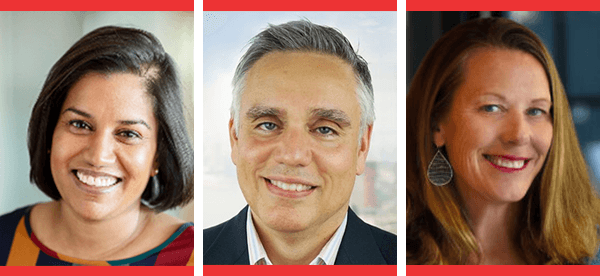
Payal Agrawal Divakaran, .406 Ventures
Steve Krupa, HealthEdge
Michelle Snyder, McKesson Ventures
Subscribe ON iTUNES

Don't miss an episode. Join the conversation by visiting our podcast channel on iTunes today and subscribe. It's fast and free!
 SUBSCRIBE ON iTUNES