Candid Conversations with Digital Health Innovators & Business Leaders
Welcome to the Breaking Health Podcast
Conversations between VCs and entrepreneurs typically occur in boardrooms or coffee shops. In the Breaking Health Podcast, you get a seat at the table. Our hosts bring their investor insight to revealing conversations with the most disruptive CEOs in healthcare. Listen to understand how these leaders are building the companies – and fostering the cultures – that will change everything.
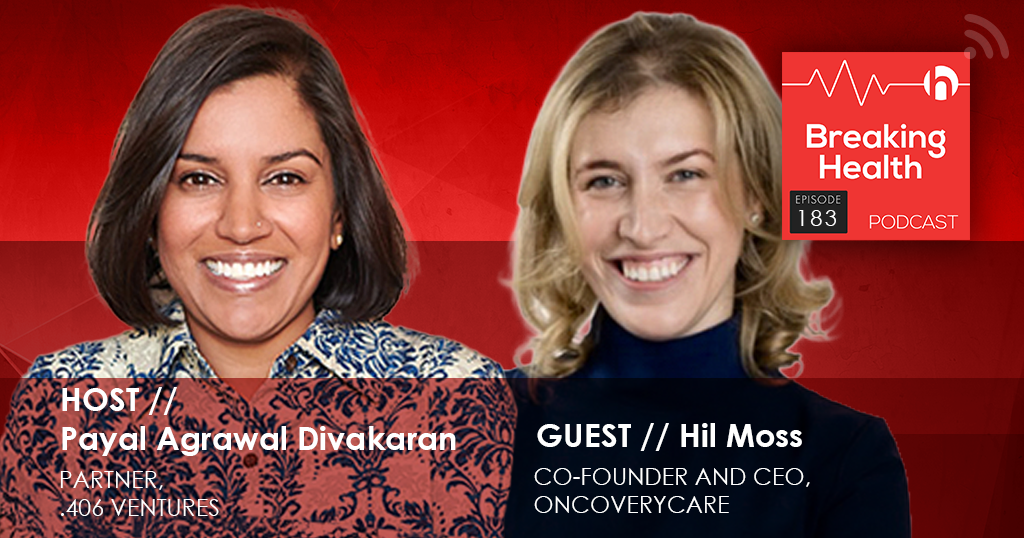
Host Payal Agrawal Divakaran talks with Hil Moss, Co-Founder and CEO of OncoveryCare about why survivorship care starts at diagnosis and why the US healthcare system is not built for the fast-growing survivor population. They dig into the real symptom and risk burden survivors carry, how an oncology-integrated “medical home” can close the gap, and what it takes to build a clinically credible company from lived experience.
Conversations between VCs and entrepreneurs typically occur in boardrooms or coffee shops. In the Breaking Health Podcast, you get a seat at the table. Our hosts bring their industry expertise and insight to revealing conversations with the most disruptive CEOs in healthcare. Listen to understand how these leaders are building the companies—and fostering the cultures—that will change everything.
GUEST BIO
Hil Moss, Co-Founder and CEO, OncoveryCare
Hil Moss is the Co-Founder and CEO of OncoveryCare, the first virtual survivorship clinic delivering comprehensive, whole-person care to cancer survivors. OncoveryCare deploys a survivorship-trained clinical team (working closely alongside oncologists) to treat the chronic and late-effects of each survivor's cancer treatment, and equip survivors with the tools they need to manage their survivorship journey. A young breast cancer survivor, Hil is an active advocate, mentor, and writer in the cancer community (published in outlets such as New York Magazine, Cell, and STAT). She holds a BA from Princeton University, and an MBA/MPH from Yale University.
HOST BIO
Payal Agrawal Divakaran, Partner, .406 Ventures
Payal is a partner at .406 Ventures, where she co-leads the healthcare investing practice. .406 Ventures is a Boston-based venture capital firm with over $1.3B under management. .406's world-class founders and digital health companies are transforming healthcare technology and care delivery. Payal leads .406's investments in AristaMD, Diana Health, Equip, FamilyWell, Heartbeat Health, Humata Health, Nema Health, Nomad Health, OncoveryCare, Vitalize Care, and Wellist. She has also supported Better Life Partners (acquired by Groups Recover Together), Laudio (acquired by Ascend Learning), Redox, Wayspring, and WelbeHealth. Before joining .406 in 2015, Payal co-founded a company called SpotRocket while at Harvard Business School (HBS). Prior to that, she worked at Eventbrite, Spectrum Equity, and J.P. Morgan. Payal is a member of the board of trustees of Dana Farber Cancer Institute, a venture capital advisor at HBS, an advisory board member for Boston Children's Hospital Innovation & Digital Health Accelerator, and a mentor for MIT Sandbox. Payal received her master's degree, with Distinction, from HBS and her bachelor's degree in electrical engineering and minor in management from MIT. She is a Boston native and die-hard Celtics fan. She and her husband and two children live in Brookline.
TRANSCRIPT
Welcome to the Breaking Health Podcast, a series of discussions with the most productive CEO and leaders in digital health.
Payal Agrawal DivakaranWelcome to the Breaking Health Podcast. I'm your guest host, Payal Agrawal Divakaran, partner at .406 Ventures. And I am joined by Hil Moss, founder and CEO of OncoveryCare. It's breast cancer awareness month, so there could be no better guest and company than Hil. Welcome.
Hil MossThank you so much, Payal. It's such a treat to be here.
Payal Agrawal DivakaranHil, tell us what OncoveryCare does as a company for those who aren't familiar with it. And I'm always amazed that people don't have a sense of the scale of businesses that are startups. So give us a sense of where you are today.
Hil MossSure. And again, thank you so much for having me. Really excited to be here. At OncoveryCare Care, we are a cancer survivorship care company. And so we have a novel care model for the long-term care of cancer survivors, those living with or beyond a cancer diagnosis. You can think of us as a medical home for cancer survivors. And we can talk a little bit more about this later, but survivors of cancer actually face a number of very unique challenges, medical, behavioral. And really, there is a very, very significant gap right now in the care of these patients. And so that is really the gap that we aim to fill. We have a model through which, and we can talk more about this, we actually plug directly into oncology teams at oncology practices systems, cancer centers, and really work with patients for the duration of their journey. So, in terms of the scale question, as you mentioned, we actually have two kind of fundamental first partners for us as a seed stage company. They are actually two of the top five largest community oncology groups in the country. So we have had our work cut out for us. They are Tennessee Oncology and New York Cancer and Blood. So Tennessee Oncology sees about half of Tennessee's cancer patients. And New York also has a very substantial subset of the New York cancer population. Between the two, we are live across a little over a hundred clinics with a couple hundred oncologists and thousands of patients. And it has just been such a great journey to see and learn from the delivery of care to this population.
Payal Agrawal DivakaranNow we're going to talk about how
patients get to OncoveryCare. But before we do that, cancer survivorship may sound self-explanatory to some folks, or it may be an entirely new concept. I know years ago when you and I were both in our separate areas, we were early thinking about cancer survivorship. And it was that early thinking that had us meet and join forces. But what is cancer survivorship in clinical terms? Paint the picture for us.
Hil MossYou know, I would ask for those who are listening who have encountered the phrase cancer survivorship, I would actually ask you to also put aside any pre-existing notions here because I think survivorship has really been fundamentally misunderstood. So when we think about cancer survivorship clinically, what we are talking about is really the care of those living with and beyond cancer. And I say with and beyond cancer for a very specific reason, which is that medically the definition of survivorship starts at the moment of diagnosis. And the experience of living beyond a diagnosis can look very different for different people, right? So you have folks who are potentially diagnosed with an early stage cancer. They might go through active treatment, they might go into a period of what we think of as remission and live many years beyond that diagnosis. That is survivorship. It is also survivorship to be diagnosed with cancer and in the thick of treatment, right? And so this looks very different for different people, but there are some fundamental principles here. And what I would say is, you know, survivorship is an extraordinary thing in a lot of ways. And it also comes with a significant number of challenges. So we tend to think about these challenges really kind of in two categories. We talk about the visible symptoms of survivorship and the invisible risks. And so to start on the visible side, these are symptoms that patients know that they have. Often they have developed these symptoms due to their experience with their cancer treatment. Often these are toxicities that stem from cancer drugs. This is kind of a tough pill to swallow, right? We don't talk about this a lot because the improvement in therapeutics is extraordinary, but they do have significant impacts on all facets of the body. So for visible symptoms, we're talking about everything from cancer-related fatigue, insomnia, joint pain, genitourinary symptoms, right? Vasomotor symptoms. There's this whole range of symptom burden that we find in this population. At Oncovery, and we'll talk about our care model and how this works for patients. The first step for every single one of our patients is that they receive a symptom burden assessment. And one of the more staggering things, in my opinion, that we found from launching this company has been that our median number of symptoms in patients that we meet with is 13. And these are all existing at the same time, right? So there these are significant. They can also evolve and change over time. But for many patients, even if they are in that remission phase, they are lasting many years later. So that's the visible risk side. Where things get really interesting, and I think really are not talked about enough, is actually on what we call the invisible risk side. And this can really fall into two buckets. This falls into the bucket of kind of long-term treatment toxicities and also risk, risk of recurrence, risk of secondary cancer. So in that first bucket, there are, as I mentioned, very significant impacts of some of these drugs that can appear many years later, unfortunately. And a perfect example, Payal, you and I have spoken about many times, is cardiotoxicity. And there are others like this, but I think this is a very strong example. If a patient, for example, is given a cardiotoxic anthrocycline for chemotherapy, it is very possible that they actually might have challenges with their heart moving forward. It's something they need to be screening for, understanding. This hasn't been a part of the conversation previously. And then we also have this bucket, of course, of risk and thinking about risk reduction for cancer. So, what is this person's risk of cancer recurrence? What are the levers available to them to both manage that risk in terms of their behaviors, in terms of their screening protocols, et cetera? And in certain cases, there are also risks of secondary cancers from the treatment, right? So we think about folks who may have a secondary cancer resulting from something like radiation. So, all to say, I think for a very long time we have thought of survivorship in many cases as ringing the bell, as support groups, as marches to bring people together and raise awareness of cancer. It is not to say that all of those things are not extraordinarily important, but what we believe is that survivorship care is inherently a complex medical field of practice, right? Some folks are saying this actually is going to become the next subspecialty of care. This is an area with a population that didn't exist before. And now we need to think about how we tackle that medical complexity of survivorship.
Payal Agrawal DivakaranYeah. And you said the word population. And the numbers are actually starting to become staggering that you can think of this as a distinct population. Almost 19 million cancer survivors today growing rapidly every year. And I think the projections are even light to say it's going to be, you know, 22 million by 2032. So what's going on right now on this supply-demand side? Why is this, you know, timing is everything I find for companies. And why is the timing right now for OncoveryCare?
Hil MossWe really are living through, I would say, an unprecedented time in the history of cancer. And I would imagine many who are listening have seen the news articles, have seen the stats around the explosion, both of cancer rates, of young cancer rates, and also of these sort of miraculous improvements in therapeutics that are keeping folks alive. What that means is that there are
many, many of us on this planet now. And I say us because I am a survivor myself. I am an eight-year survivor now of early onset breast cancer. And there are, there is a significant and increasing awareness, I would say, of the impact that this is having on our world. But what we haven't figured out is how our system is actually going to tackle this increase in the number of survivors. So we like to say, you know, when you start a healthcare company, right, you look at the different forces in play and the different challenges. And I think so often in cancer, just like in so many other areas, you come down to the fundamental concept of supply and demand. And you say that there is on the demand side right now in cancer this, as you put it, exploding population of survivors. And we can talk about the reasons for this, right? It is partly due to an increase in cancer incidence. It is partly due to increased screening protocols. As I mentioned, it is due to improvements in therapeutics. But whatever those forces are, it is leading to this drastic growth in this population. Now, on the flip side, though, on the supply side, we actually are already facing an oncologist shortage. And we're particularly seeing this in in rural areas, but even in urban areas as well. And this is a crisis that we are going to have to resolve sooner rather than later. And what this means is we have an imperative to think about how we actually restructure our systems to address this. And, you know, look, the the final thing I'll say here is I think it's very interesting to think about principles of design thinking, actually, when you're building a company. And often what you talk about is, you know, what is the fundamental problem for something that you're solving? Cancer care today, as we know it, was designed to solve a different problem than the one we have now. So if we go back, you know, one of my favorite books of all time, I can't recommend enough, is Emperor of All Maladies. It charts out the history of cancer care. And if you go back 75 years and you say, okay, where were we at in 1950 when we were developing the modern cancer care model of today? It was a different world. It was a population of folks, you know, where you had essentially a quite frankly, highly lethal disease impacting a smaller population of patients. And that's not to say that there are not cases today where this disease is not still lethal. But you fast forward to 2026 and you say, oh my goodness, the five-year survival rate for all cancers that used to be 35%, you know, we now have a vast majority of folks living. And so what that means is then if you have a different problem statement you're solving for, then you have to reinvent the model, right? But we haven't done that yet. So all of this progress in cancer, the therapeutic progress, the you know, developments in the structures of cancer hospitals, it's extraordinary. But the one thing that hasn't changed is actually the model. And so that's where we really believe that survivorship, believe it or not, plays a key role here.
Payal Agrawal DivakaranYeah. And when .406 was thinking through our thesis, it was this kind of five-year or so evolution, understanding what was going on here in Boston with places like Dana Farber, which do amazing, you know, cancer survivorship care, to say, how can this scale and how can this be provided to more patients? And and this inkling that cancer is gonna now be more of a chronic condition. And so that's sort of what led us to believe that there was a population-oriented approach here. So now let's get to how does Oncovery work and what do patients get in terms of a care model when they experience OncoveryCare.
Hil MossSo when we first started the company, we had a strategic decision to make, right? Like all companies do about your go-to-market. And we knew we had this model, and I'll talk more about that, that we believed was the appropriate delivery of care for cancer survivors, but we had to figure out how do we get from A to B, how do we get this in the hands of our patients? And an early decision we made that we thought was a non-negotiable was this has to be integrated deeply with oncology. And, you know, the reason for that was actually twofold. The first is that care is already fragmented, healthcare is already fragmented, right? And cancer survivors really experience this more than anyone else. We actually have a phrase we like to use in our team when we talk about survivorship. We talk about the hot potato problem. And survivors often feel this way. They exit the active treatment phase of cancer. Maybe they try to go see a primary care physician, but a primary care physician was not trained in cancer survivorship and actually baths them back to oncology while oncology is busy. So survivors already have this fragmented experience. And so we said, you know, we have to figure out a way to make this really a very continuous care journey. So that was the first reason. Quite frankly, the second reason was there is a really unique bond. And I will say this myself from personal experience between a cancer survivor and their oncologist and that very unique relationship you build during that period of time where they are managing your treatment. We did not want to create friction there. We also knew that if we were to be successful, we needed those oncologists to trust us. And so the best way that we thought we could do that in our earliest days was actually to integrate deeply with oncology partners. So the way that our model works is we have a survivorship trained care team. These are oncologists, medical directors, nurse practitioners, therapists, psycho oncologists. And this team is both trained in survivorship and our protocols, but we also leverage technology enablement tools on our end to equip these folks with, you know, the information and the tools they need to deliver this care effectively because it is rather complex. And we actually bring that team entirely under the umbrella of oncology groups right now. So you can think of our providers as being credentialed under the MPI of these groups. We are by all means an extension of their care team. And what that means is that we can identify patients for survivorship care in two ways. One is an oncologist can make a direct referral right in the EMR. We're in there too. The other way is that we have actually built an algorithm in-house to identify folks in the post-treatment phase who are eligible for survivorship care. So we actually receive a list of appropriate patients. Because we are under the umbrella of the group, we can call on behalf of their care team and let them know hello, you know, we are calling from Tennessee Oncology Survivorship. This is the team that you're going to be working with now. And at that point, the patient can transition into our
care. Now, every single patient starts the same way as I mentioned. They have a symptom burden assessment so that we understand exactly the needs and the challenges that they are facing. The other thing that they have is really a very substantial initial consult with our nurse practitioner. And that's when they can really start to dig into the things that they are facing, you know, helping them to understand their risk moving forward. From there, we then deliver and kind of make personalize the care model. So this person might continue meeting with our nurse practitioner to address certain side effects or challenges they're facing physically. We're going to be in touch with that patient, making sure that they have the appropriate screening and surveillance. And if they have behavioral health challenges, which I will say many survivors do, they are actually rooted as well into our in-house survivorship trained behavioral health team. All along the way, and this is, I would say, the most important part, we are in constant communication with their oncology team so that that oncologist, those APPs are fully aware of everything we're doing and really serving as a member of that core to go so there's two things I I love about the model you described.
Payal Agrawal DivakaranThe first is full medical and mental health care for survivorship. So that kind of whole person care element. And then the second is the tight integration with the existing system. I think there are many places where delivering something outside of a system makes sense because it's just not possible in the ex incumbent. But in Oncovery's case, you know, oncologists are they are the quarterback, you know, for that relationship. And so how to empower them to do, you know, appropriate care and how to leverage that relationship and make it a win-win. I love when there's those elegant models. So that's great. All right. I want to shift to you and your founding journey. You know, you you referenced it earlier, which was that, you know, you were you're a cancer survivor yourself and you weren't always in healthcare. So let's talk about that transition and and how it happened.
Hil MossI definitely was not in healthcare. So I actually, if we work backwards back to 2018, up until that point had been working a very different type of job. I actually had been working as a strategy and business consultant in the arts and culture world. So I worked with major museums and theaters, nonprofits on board management, strategic planning. And it's funny, it was it was a wonderful job. I loved it. It was also, you know, full of travel and extremely busy. And in 2018, I decided to leave that job and start an MBA program, actually at the time with the idea of staying in that world. But because it had been such a crazy period of time at work, I actually remember very specifically, I made a decision. I was taking two months before business school. And the goal that I gave myself was that I was going to get healthy. And I remember I did everything I could to that end, that I was traveling, I was sleeping enough, I actually did my first triathlon. And I remember saying to a lot of people, I feel as healthy as I ever have in my life right now. And of course, the ultimate irony of that statement is that I almost certainly had breast cancer that entire time, unbeknownst to me. So I ended up starting business school. I made it about two weeks of orientation and four weeks of class. I was sitting in a microeconomics lecture when I looked down and I was getting a call from Yale Health, and I got on the phone, and the person on the other line told me that I was diagnosed with breast cancer. And at the time I was 28. I had no family history. So this was certainly not on my agenda for that time. But ended up, you know, by the next day coming back here to Boston where I'm from, I started treatment at Dana Farber, and that was the first of 15 months of quite aggressive breast cancer treatment. And at that time, I will say, obviously, it is still staggering when you hear of a young breast cancer diagnosis now, but there's actually been a lot in the news recently, and I'm glad to see this building awareness of early onset breast cancer. But at the time, you know, you said you were 28 with breast cancer. It was like unheard of. And I said, you know what? Maybe I could do some good here while I'm going through this treatment and just start sharing my story a little bit and helping folks understand what this, what this is like. And so I got more and more active in the cancer community as an advocate and a writer and a mentor. And ultimately what happened was I, about 12 months into my 15-month treatment, went back to business school to start over, spent a couple of months saying everything is exactly the same as it was before and cancer will not change me. And then very quickly had one of those classic middle of the night aha moments where you just say everything has changed. And I have seen and learned so much in this space, I just have to focus on it. And so I started popping around the cancer care innovation space truly just to see where I could fit. I mean, everything from I was doing MA consulting for a med device group and some patient acquisition work for a liquid biopsy biotech, a little bit in digital health. But what ended up happening was starting to notice this pattern in the conversations I was having with fellow survivors and in my own life of the challenges of survivorship and end up saying this is just too interesting of a white space not to build something.
Payal Agrawal DivakaranAnd I'm so glad you made that jump because the the work that you're doing now is just incredible. But you don't do that work alone. And so there's a team and there's a co-founder here. So tell us about you know how and why you chose the co-founder you did.
Hil MossWell, this is one of the best and most serendipitous things that happened throughout my entire journey. So just to go kind of step back for one second, when I decided that I wanted
to start a cancer survivorship company, you know, they say companies often start in one of two camps, right? You either have a problem and then you seek the solution, or you have some sort of technology or solution and you work backwards and find the problem. This company was so the former. Like I knew from my own personal experience that this was a challenge, and I'll, you know, I'll speak to this for a second. You know, kind of.
Payal Agrawal DivakaranUntil just on that, yeah, I would submit that only the former ever works. Like, you know, having a hammer, trying to find a nail, it just I've never seen because the things are never a straight line and it's always, you know, going to be different than you expected. But if you know something must, you know the problem and you know a solution must exist, I think that's when great things happen. So I think that you made the right call there.
Hil MossI'm certainly inclined to agree. But I knew, and that's really where this fire came from. I mean, I am someone who loves a plan, loves a calendar. Some might call me type A. And when you are in active cancer treatment, for better or worse, that's actually what you have. You have a giant binder, and I had all my subfolders, and I knew exactly what I was going to do week to week. And then after my 15 months, I had my final infusion at Dana Farber. And two things happened. One was I finally had the space mentally to reckon with and start to digest what had actually happened to me. And in particular, not only the cancer treatment, but the knowledge that I live with an ATM mutation. I'm at risk of other cancers like ovarian cancer, pancreatic cancer. And it was a real struggle for me from a mental health perspective. The other thing was happening was that I was starting my hormonal maintenance therapy that I am still on to this day. I'll be on for, you know, somewhere between five and 10 years. And I was having very significant, somewhat scary side effects at times gynecologically. And I felt like I didn't have a place to turn. And so I knew this was a problem. And I'd seen it and I'd heard it from other survivors, but I didn't know what the solution was. So in the spirit, I mentioned design thinking before, I started just talking to people. I put together survivorship dinners. They were virtual. This was COVID times. And I brought survivors around a virtual table and just said, what would be helpful to you in survivorship? And I had mock-ups. You know, would it be this app or this community or this tracker? And basically what every single person said to me was, Hil, I don't know, maybe I'd use that app, maybe I'd use that tracker. But what I need is healthcare. And that was when it became extremely clear to me that this was going to be a clinical care model innovation. And I was certainly not going to develop that myself. I was going to need someone on the medical side who really saw this. Now, Payal, you and I have talked about this before. I am like LinkedIn's biggest fan. I have met many of my favorite people through LinkedIn, including you. And I will say that that is exactly how I met Justin. So I had been putting out a lot of stuff into the universe about my thinking on survivorship. I got a note from Justin who said, Hey, I think we're thinking about some of the same things. Let's talk. And Justin, at the time, he had trained in internal medicine here at MGH, the time he was in the cancer care innovation group at Penn, and he had been thinking about these issues from the clinical side. He had seen this in his practice, feeling like he wasn't doing right by cancer survivors. And so the two of us got on a Zoom, and it was one of those things where your kind of voices, like the volume and the pace, start at one level. And then by the end of the conversation, they're both higher and faster. And I think we just knew by the end of that call that we had to work together. And so he is our co-founder and chief medical officer. He has really been, you know, the driving force behind our care model, our clinical interventions. And it would, this company would not exist without him by any stretch of the imagination.
Payal Agrawal DivakaranYeah. The funny thing about that story is the way that you met Justin is, like you said, is exactly the way you met me. I reached out to you and said on LinkedIn, I think we're talking about the same things. I think we care about the same things. So it's amazing that serendipity. But I think the fact that you partnered up with a clinical co-founder is so critical. This is at the end of the day, this is a clinically oriented business. And when you're trying to deliver a new model of care, that clinical underpinning is so important. And that's where at .406 we're just sort of maniacal about what is, what are the evidence-based pathways? What are you, what data are you tracking? What are the outcomes? Are you going to get peer reviewed and published? And I know those are all things that you're working on at OncoveryCare, which I think come from, you know, that that clinical lens of that co-founder. So I I really do love that. But, you know, you in as you thought about your founding journey, and even today, you know, you are the CEO of effectively a clinical business. And so how does it help to not be, you know, clinical and at the helm? And where do you feel like, you know, there's some blind spots that you've worked on over time?
Hil MossIt's interesting. I have certainly heard the argument made that there is benefit to founders coming in from outside the system to change things up. And particularly when you're someone with lived experience, I certainly think and hope that I bring value and a fresh perspective from the survivorship side. But I'll be honest with you, this is something I think about every day. And I think it's important not to fall in the trap of thinking that you're so outside the system that you don't need to learn just how the fundamentals work. I mean, I challenge myself every single day to be reading, to be digesting information, to be talking to the clinical folks on my team. I will say, I think at this point my co-founder said I'm falling somewhere in like resident land now in terms of my knowledge. So I'm really trying. But I actually think that any executive of a healthcare company, any founder who is not clinical needs to be very aware of that and be very aware of any blind spots because yes, there's room for innovation, but healthcare is also a system that is highly complex, that you know, medically operates on, you know, extremely precise, you know, protocols, but also that just has a lot of nuances that you can't ignore and put to the side because they will cause problems later on if you aren't addressing them. So I think you need to put the onus on yourself to stay sharp and to bring in the right people to know what you don't know, because otherwise you're setting yourself up for a problem.
And I wouldn't diminish that lived experience piece. Yes. I think that is just it's almost mission critical. And I've the other founders I've had on this podcast, right? Kristina at Equip or Jess Gaulton at Family Well or Kate at Diana Health. I mean, the lived experience is part of what the attraction was for .406 around knowing that they were gonna know how the be able to find the right solution for the problem. And I say that about you. And and it also just it it helps give that extra fuel because things are so hard. And one of those examples, you know, not being clinical, I think you and I have spent time talking about just managing a healthcare clinical team. It's just not the same as a tech team of engineers. It's just got all different challenges, right? And so that's I think one area where I remember having a conversation with you, and you just said, look, I just I didn't expect this because I yeah, I came from a different world. 100% all right. Well, I think the other question founders often ask me is just how the heck do I get my first enterprise customer? So what was the unlock or the secret? How did you get Tennessee Oncology, which is not just a first customer, but a massive first customer? What were some of the nuggets there?
Hil MossYou know, this is where I will say I really do believe some of the key here is in putting yourself out there and talking to a lot of folks and building relationships over time. And I will say, and this is not for everyone. So this is my personal opinion and experience. I made a decision very early on to not put this company in stealth. And the reason for that was that I believed it was too important of a problem not to be talking about. And quite frankly, if someone else built a company in this space too and they were also trying to solve the problem and we could just outperform them, then that's actually the best possible scenario because this care needs to exist. So I said, I am just going to put this out there. And by putting it out there, started to meet a number of amazing people. And one of those people, or I should say, like a series of folks, were the leadership team at Tennessee Oncology. And they had actually identified this on their executive leadership time, executive leadership team rather, as a challenge that they were looking into. And so we got on the phone. I remember it was us and uh at the time their chief medical officer, Stephen Schleicher and their CEO Natalie, their CFO Ron. And I'll be perfectly honest with you, we just had one of those magical conversations where it seemed like we were thinking about things from the same standpoint. And, you know, I know that we are going to talk probably in a little bit about our financing journey and about how you and I came to know each other. But of course, as it goes in this world, there was the small world of you also having gone to business school with Stephen, who was the CMO of Tennessee Oncology. And there was this moment where you could actually look and say, wow, we have a startup and a venture fund and an oncology group, all of whom independently arrived at this conclusion. What if we came together and really did this? And so, you know, I would say that's been instrumental. The other thing I will say, and I think about this a lot, is we live in a world now where companies tend to be virtual, teams tend to be remote. You gotta get out there and talk to people and meet the people and be local. I mean, I have actually had such a wonderful time, as you can imagine, getting to go to Nashville quite a bit. But I I do have to say I don't believe you can build those relationships entirely virtually. You gotta put yourself on the plane and and talk to people.
Payal Agrawal DivakaranI 100% agree. And the confluence of all of this coming together did lead to your fundraising. So let's talk about that. You know, how did your seed round that come together? Let's talk a little bit about that. And, you know, I'll give my perspective after yours.
Hil MossYeah, absolutely. So, you know, up until the point that we met, I had tried to be scrappy and creative. And so I got the company off the ground while I was in business school. I do as a side conversation. I'm a big advocate for starting companies in business school because you could actually get the time and some very basic funding to get you off the ground. After that, I had pulled together some different sources, everything from Techstars to our investor Ben Freeberg, who at the time was starting a cancer venture fund. You know, we actually did an SPV together before he even had a fund. Now he's raised nearly 100 million. But really trying to think about how we get these kind of early believers engaged. And that was helping us to get the company off the ground. But when you and I first met, it was actually still very much in those very early days. And I remember you and I actually met before I'd even connected with Justin. So I didn't even have a co-founder yet. And I remember you and I got on the phone. We talked about our kind of joint belief in survivorship. And I remember you said to me, Hil, this is great. We love this area, but you don't have anything yet. Like you don't have a team, you don't have a model. And I remember you said, come back to me when I when you have a team. And I said, Okay. And eventually I met Justin. And I remember we got back on the phone and I said, Hey, guess what? I have this great co-founder and now we have a team. And you said, Okay, well, now you need a model. And, you know, we just kind of kept that touch point going up until the point where, again, we had the model, we had the customer coming on, and it was really a time to kind of all come together and think about this financing. But I don't want to speak for you, but I would imagine part of the magic here was actually getting to know each other and working through this kind of joint idea together and seeing it evolve in real time.
Payal Agrawal Divakaran100%. The thesis was years in the making of understanding cancer survivorship, the population, what is needed and what's possible. And the biggest unlock was meeting you, even that first time, because I just knew that you were gonna figure this out. And so there from there, my head went to all right, we'll tell you the other puzzle pieces that are needed for this to be fundable. And but I do think even when we invested in when we led the the four and a half million dollar seed round, we took a big leap of fate because it's but we were able to do that because we had such a good understanding of the space and we had gotten to know you over time. And and then to your point, Tennessee Oncology invested alongside us. So you could say, okay, here is where you know the the customer
relationships are gonna start. So I entirely agree that this was there was a lot of serendipity, but now when you look back, you sort of just say all the right people were starting to get together, including Stephen Schleicher, who you mentioned, who we've now funded for his next company and uh Tennessee Oncology. So it was just the right people at the right times over a long period of time. So you mentioned some of your VC partners. What advice would you give to founders around selecting VCs and how to think about that?
Hil MossI'll speak specifically to uh healthcare companies, healthcare services companies in in particular, and just say I was really thinking about honestly two things. One was healthcare services, belief, and experience, and the other was just trust, honestly, and and relationship. I'm to speak first about the former. Look, I am a huge believer in technology. I am the daughter of a technologist. I grew up, you know, always exposed to, you know, things five years ahead. I do believe that technology is going to be crucial to how we reinvent healthcare. I do not believe it is the only panacea for the ills that face our healthcare system. And so it was incredibly important to me, particularly when we were building a tech-enabled services model, that we found investors who were deeply knowledgeable in this space. You know, kind of honestly not dissimilar to the point I made before about kind of checking myself for my own healthcare expertise, right? Making sure that any capital we were bringing in was really rooted in kind of this deep, rigorous clinical understanding. And I think we were very lucky to, you know, then get to work with investors who kind of check that box. And then I know this is squishy, but truly getting to know one another, the trust, the relationship you build, you know, you will be working alongside folks as team members. And I think having that alignment is is absolutely essential.
Payal Agrawal DivakaranYou said it really well. There's from the VC perspective, you're gonna go through hopefully some great celebrations and moments together, like that first customer and you know, seeing your first hundred patients and all of that. But then you're gonna go through some really tough stuff. And so you've got to be able to work through that together. And I think that's when you know the real partnerships are are discovered and made. And so feeling like you can do that if you have the luxury of choice, the VC partner, I think is really, really critical. And and I'm just grateful you took that that bet on us and on .406. So last thing before we go into the rapid fire segment, what should listeners expect out of OncoveryCare three, five years from now? What's your vision for the company?
Hil MossLook, we have one fundamental goal. That goal is we want to be there to care for every survivor in America at some point, right? We want to be the entity that is associated with cancer survivorship, this challenge and this fundamental care model. And so we are going to continue firing on all cylinders in that regard, continuing to grow our presence. You know, New Market launching in early next year. So excited to share more about that. And continuing to grow in both regions across the country, but also continuing to grow our presence as you know, a thought leader in this space, as someone who is just making a ton of noise about this challenge and this issue, and also really serving as a convening force for survivors in this country around the world. You know, one of the things that I kind of speaking of unexpected things that I might not have thought of before serving this company, actually, one of the joys I get, believe it or not, in the startup phase is doing some of our hiring. And part of the reason is it is just a pipeline of folks that you meet who are as fired up about survivorship as we are. And it's like you join, you have this kind of army of people who are fighting this mission and you just start adding to that. What percentage of the company is can't are cancer survivors? We have a significant, I don't want to, I don't know the exact number off the top of my head, but a significant portion of particularly of our operators are cancer survivors or folks who have delivered this care previously in care settings seen the need, believe in it so deeply. So yeah, we got we got a big battle to fight here to help folks, you know, really understand why this is actually not only critical to these survivors, but it's essential for the system. And so we got our work cut out for us, but it's it's fun.
Payal Agrawal DivakaranThere's such a big opportunity ahead. I I think there's a few rare ingredients here. I mean, big growing population and opportunity in what you're delivering is novel and disruptive. And it's just not very often that you see all of those things come together with exceptional people. And so I'm really excited about the next few years ahead of for
Oncovery. So let's shift last, you know, kind of five minutes. We're gonna blaze through some topics and just see what's on the mind here. So I'm gonna throw a curveball at you, is just survivorship. Does it start at the time of diagnosis or does it start at the end of treatment?
Hil MossStarts the time of diagnosis. And this is going to become this definition more and more important, honestly, because we are going to see folks now living with cancer as a chronic disease, right? And these folks are survivors. There is something that happens when you receive that call, when you see that message, whatever it might be, and you discover that you have cancer. And everything that you go through from that point forward, it might look different. You might spend a certain amount of time in treatment and then a certain amount of time in remission. You might live out your life on some of these more novel therapeutics and cancer drugs. But fundamentally, this is a state of being that applies really to anyone who has had this lived experience. And the only other thing I will say in our rapid fire is we also have a phrase that we like to use a lot, and that's co-survivor. And the co-survivor is the person, the family member who might be caregiving for the patient, who might be living this alongside, right? That is actually also a very unique and complex state of being. And so we've got to think about our co-survivors as well.
Payal Agrawal DivakaranI love that. I would say you have changed my mind on this topic prior to investing in Oncovery. I felt differently, but now I agree with you. And I've also, it's been further embedded to me as I've been on the Dana Farber board and see how they think about survivorship. Yeah. Pink October, it's breast cancer awareness month. Is that moved the needle in the right ways? Is it marketing or mission or something else?
Hil MossGood question. So on the one hand, I think October and Breast Cancer Awareness Month is one of the most fascinating examples of the branding of a disease that you could ever actually point to. And in some ways, it has been extraordinary. It's actually a very interesting, if you ever want to look into it, the history with the Lauder family from Estee Lauder, like really amazing driving forces behind awareness, behind, you know, helping folks understand they need mammograms. The problem is pink washing. And so pink washing, when we refer to that, what we mean is companies who are potentially kind of slapping pink ribbons on products to sell products, but are not actually doing anything with the funds they receive to contribute to the cause. And so, you know, I always say I think breast cancer awareness month should turn into breast cancer action month. If you are looking at products, it's actually usually pretty easy to just take a look and say, hey, is this product actually contributing to research? Is it actually contributing to discoveries for our stage four patients, making sure their kind of money is where their mouth is?
Payal Agrawal DivakaranSpeaking of action, actually, over the weekend, I was driving the kids from Sunday school to home. And we walked past the Jimmy Fund walk in this month. And so it to see that in action and to see all the way down Comm Ave from Newton to you know Brookline where we came, my kids, it was just this amazing 20-minute conversation with the kids to say why are they walking? What is the purpose? What are we talking about? And so I think there is value in the visible of the month and some of the actions, to your point. I love that. So AI and cancer care. What's what's the most exciting near-term opportunity you see for OncoveryCare using AI?
Hil MossI mean, look, cancer care in so many ways is going to be revolutionized by artificial intelligence. And, you know, I won't even touch on things like junk discovery. It's incredible. For OncoveryCare specifically, I mean, look, we've already been touched by it. I mean, from when I started this company back in 2022 to now, our use of AI scribes, agentic appointment reminders. I mean, it has fundamentally changed the way that we operate our team. Where I get really excited though, and what we are working on behind the scenes is, you know, I mentioned this hot potato problem in cancer, and it often cancer survivorship can be very complex medically because of all of the systems of the body that it impacts. Because of that, there are often very disparate sets of guidelines, considerations that you need to take into account when you are treating a cancer survivor. We are actually building a model on our end to say, look, we can take the medical record of a patient, we can understand their background demographics, health history, comorbidities, their treatment, their therapeutic profiles, and actually use that information to understand not only what they're at risk for moving forward, but actually predict outcomes for that patient. And so this is really going to be what enables and what does currently enable our team to, you know, see a stage two breast cancer patient at 10 a.m. and a stage three colorectal patient at three, pancreatic at four. That would be very difficult to do with the scale and complexity of the care without artificial intelligence. So I am extremely optimistic.
Payal Agrawal DivakaranI'm just gonna give your comments two thumbs up because I would have the same thing. I think what you've done is is is exceptional there.
Okay, last two ones. So, first is about entrepreneurship. You watch, you mentioned being part of an entrepreneurial family, watching it from a young age. How has it set you up for success? And I have my thoughts.
Hil MossThat's such an interesting question. So, yes, my father Frank, serial entrepreneur across many different fields, everything from software, hardware, media, life sciences. I mean, first of all, just on a very basic day-to-day level, I feel like the luckiest person because I have a built-in 24-hour startup therapist who is always excited to both talk to me about challenges and also like play around with Claude. So that's just been a real gift. But it also, I think, gave me exposure from a young age into what it takes to quite frankly see things early and then bring people along with you. And whether that is teams of people, you know, supporters through investors, external sources, whatever it is, I saw the power of story and the power of buy-in that my father would build. And I think that's something that I've really taken with me.
Payal Agrawal DivakaranI will say you move differently in this world and in this journey than most founders. And I will say those who come who have had the blessing of seeing entrepreneurship growing up, they tend to move differently in this journey and the way that you articulate things and say things, it's very evident. And so I think it's a great blessing that you have.
Hil MossI'll let them know.
Payal Agrawal DivakaranExactly. So final question besides OncoveryCare, what .406 portfolio company are you most excited about?
Hil MossSo I'm gonna cheat and say two, because there are two lived experience founders in the portfolio who have also really been resources to me and have spent time and energy with me. One is Sophia Nima in PTSD care. The other, of course, is Jess at Family Well. And we've been on kind of a similar timing in our engagement with .406, both folks who I think have lived experience in certain areas, built really novel care models to address those challenges and also really serve as examples of, you know, uh founders who are willing to take the time to connect with other founders, give guidance, give thoughts in a way that's just been so valuable to me. I mean, you can't, it's very difficult to do this journey alone. And so finding a community of folks in similar positions is just so critical to your day-to-day.
Payal Agrawal DivakaranAnd what's amazing is you can find both of those companies on this podcast, Sophia at Nima and Jess at Family Well. And now Hil at OncoveryCare. Hil, thank you for what you're doing. It's a it's my blessing that I get to work with you and see OncoveryCare's journey. And I'm just so excited for you to change the face of cancer survivorship care. So again, thank you.
Hil MossWell, I can't thank you enough for having me and just so lucky to be on this on this journey together, Payal.
Do You Have
A STORY TO TELL?

If you’d like to be considered as a guest on a future episode of the Breaking Health podcast, please complete the application today.
Meet Our Hosts
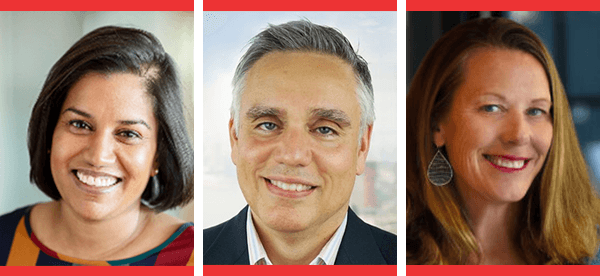
Payal Agrawal Divakaran, .406 Ventures
Steve Krupa, HealthEdge
Michelle Snyder, McKesson Ventures
Subscribe ON iTUNES

Don't miss an episode. Join the conversation by visiting our podcast channel on iTunes today and subscribe. It's fast and free!

 SUBSCRIBE ON iTUNES